Instagram DM Automation Detection: 7 Signals That Get You Flagged
Instagram does not publish how it spots automated DMs, but its spam policy and the tools' own failure modes point to 7 signals: identical text, burst timing, first-message links, inhuman typing and more.

Instagram does not publish how its DM automation detection works, but its spam policy bans activity done "either manually or automatically, at very high frequencies" and allows restrictions at lower volume when "repetitive content" shows up. In practice, Meta's rules and vendor testing point to seven signals that get automated DMs flagged: identical text, burst timing, links in message one, inhuman typing, session and login anomalies, automation fingerprints in the browser, and recipient reports.
Before anything else: automating DMs is against Instagram's rules. The Instagram Terms of Use forbid "accessing or collecting information in an automated way without our express permission." No tool and no setting changes that. What you can control is how many of the seven signals your setup sends at once.
This guide is about the signals a tool leaks. If you type every DM by hand and still get restricted, read why hand-typed DMs get restricted too instead; the habits there are different.
Can Instagram detect DM automation?
Yes, and Meta says plainly that it keeps working on it: "Our policies and detection must constantly evolve to keep up with emerging spam trends and tactics" (Meta Transparency Center). What Meta does not say is which exact signals it uses or what the thresholds are. So every claim you read about detection falls into one of two buckets.
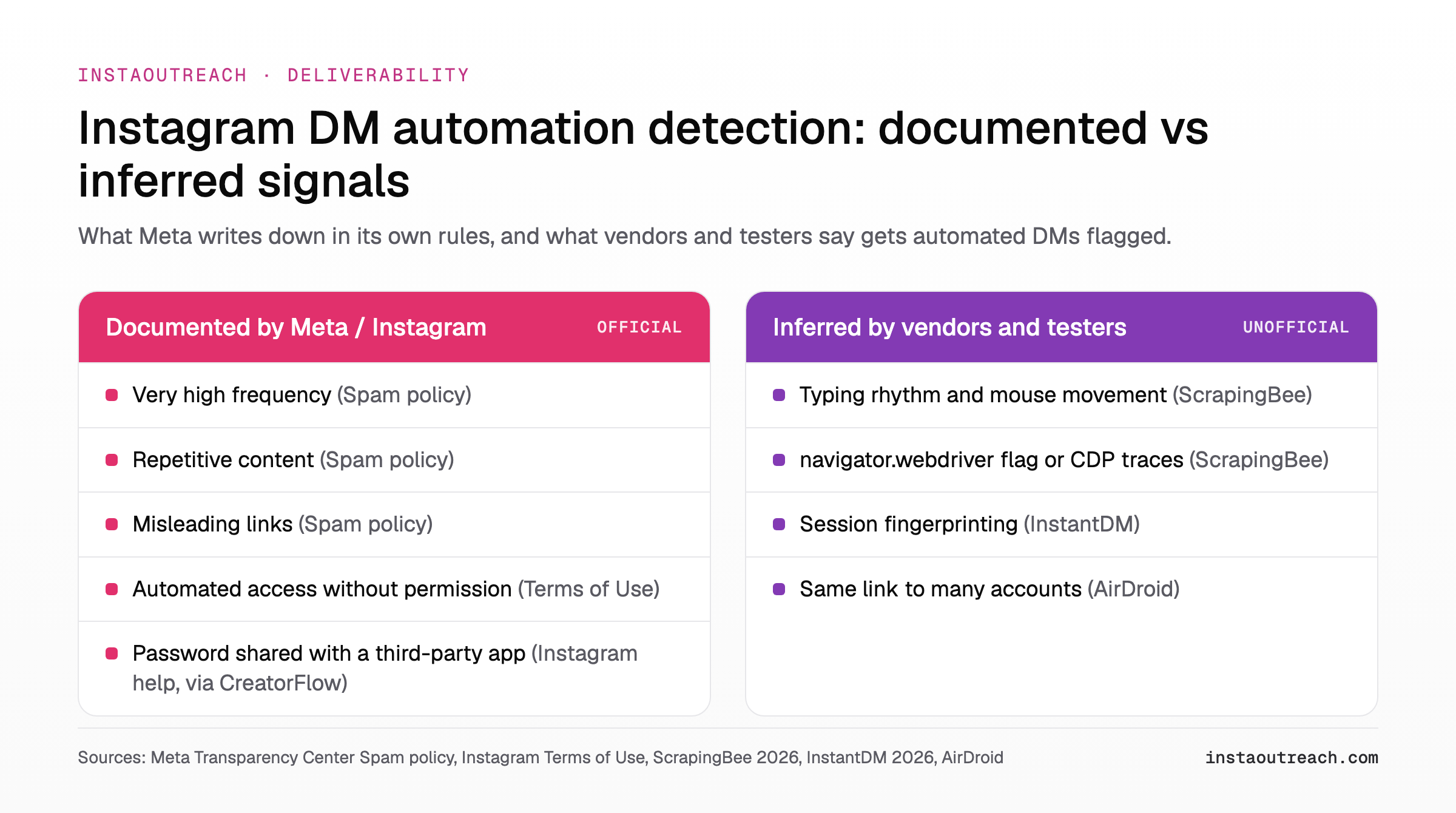
Documented by Meta or Instagram. High frequency and repetitive content are in the spam policy. Misleading links are a named rule: "Content containing a link that promises one type of content but delivers something substantially different" (Meta spam policy). Automated access without permission is in the Terms of Use. And Instagram's help pages, as quoted by CreatorFlow, list giving "your username and password to a third-party app or website" as a cause of automation warnings.
Inferred by vendors and practitioners. Typing rhythm, webdriver traces, session fingerprints and the link-in-first-message rule come from tool makers and testers, not from Meta. ScrapingBee writes that 2026 detection across platforms in general (not Instagram specifically) turns on "mouse movement and typing rhythm" and on whether automation "announces itself through the navigator.webdriver flag or CDP traces." That is a credible claim from a scraping company, not a Meta statement. Treat it as likely, not proven.
The split matters because people over-fit to the inferred list (buying fingerprint tools) and ignore the documented one (sending the same text 300 times).
Do identical messages get flagged on Instagram?
Identical text is the cheapest signal for Instagram to catch and the most common one cold outreach sends. Meta's spam policy names "posting repetitive content" as an indicator that can justify restrictions even "at lower frequencies" (Meta). You do not need high volume to trip it; repetition alone is enough to add weight.
Vendors describe it in stronger terms. Zorcha writes that when "the same message, word for word, punctuation for punctuation, goes out to account after account, it reads as machine-generated spam even if the underlying intent is legitimate" (Zorcha). One vendor, InstantDM, claims that "Instagram's language models catch it" when the same DM goes to hundreds of people (InstantDM on DEV). Neither shows how it knows. Read them as informed opinion.
Spintax is where most automation setups fool themselves. Swapping "Hey" for "Hi" and "love" for "really like" changes a few tokens but keeps the skeleton: same length, same order of ideas, same call to action, same sign-off. Any system that compares message structure, not exact strings, sees one template. The fix is to personalize the reason you are writing, which changes the whole sentence, not one word in it.
| Approach | What stays constant across sends | How it likely reads |
|---|---|---|
| Identical text | Every character, punctuation, length | Repetitive content, the documented spam indicator |
| Spun template (1-3 word swaps) | Structure, length, idea order, CTA, sign-off | Near-identical; still one template to a structure check |
| Personalized reason | Only your tone and maybe the greeting | Different message per recipient; the weakest repetition signal |
For openers that vary for real without sounding machine-made, see how to use an AI DM setter without sounding like a bot.
How fast is too fast? Instagram DM automation detection and burst timing
Instagram publishes no DM cap and no "safe" rate, so any number you see is someone's claim, not the limit. Meta's policy only says "very high frequencies" (Meta). What you can do is look at the gap between sends, because that is what makes a pattern look human or not.
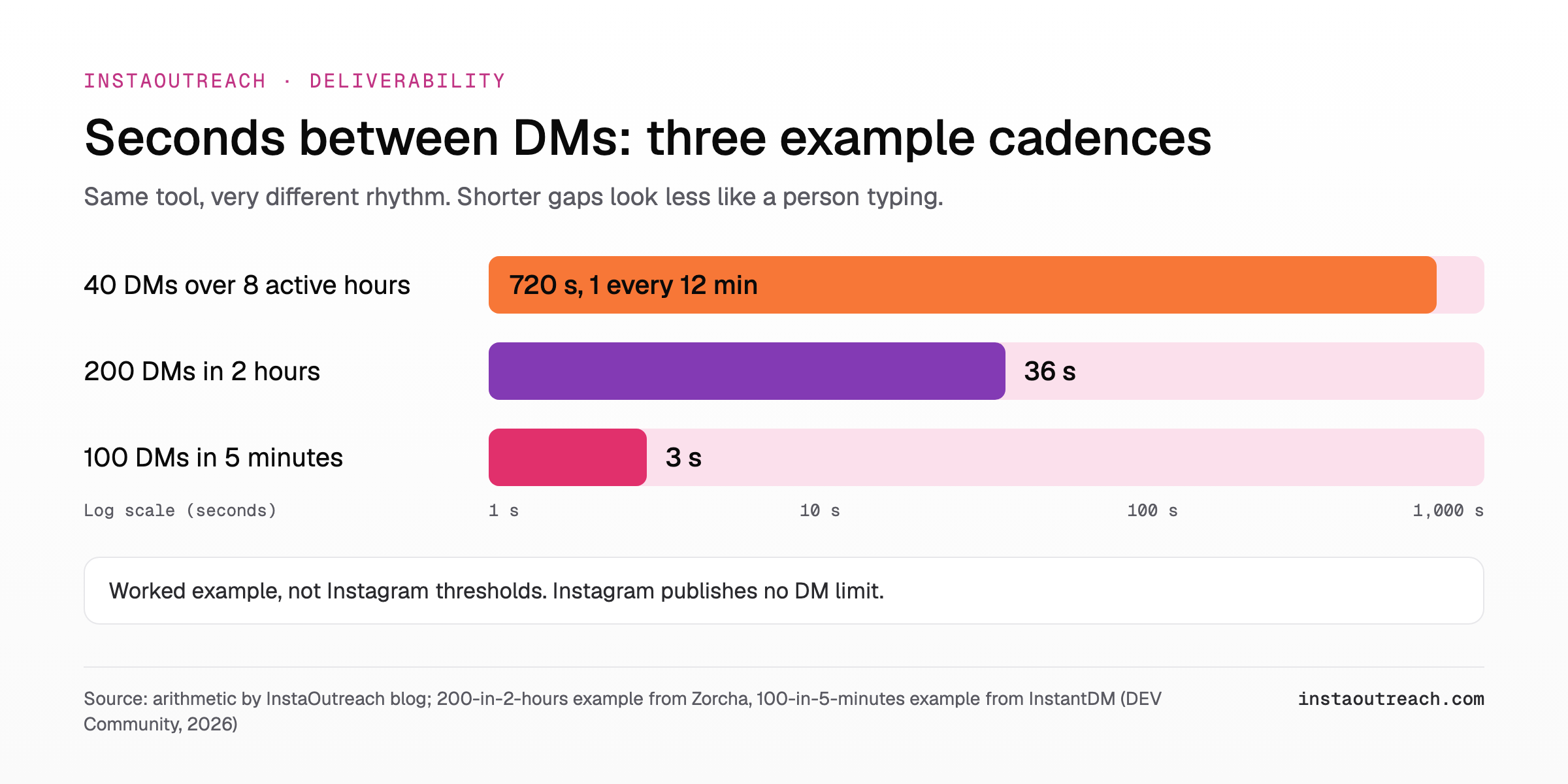
Worked example (assumptions stated, not thresholds). Take three scenarios and turn them into seconds between DMs:
- 40 DMs spread over 8 active hours: 8 x 60 = 480 minutes, 480 / 40 = one DM every 12 minutes on average (720 seconds).
- 200 DMs in two hours, the pattern Zorcha calls "not a pattern any real human produces" (Zorcha): 7,200 seconds / 200 = one DM every 36 seconds.
- 100 DMs in five minutes, the example InstantDM says real-time monitoring catches (InstantDM): 300 seconds / 100 = one DM every 3 seconds.
A person cannot open a profile, read it and write a personal opener in 3 seconds. In 36 seconds it is a stretch for one message, impossible for 200 in a row. The 12-minute average is in human range, but only if the gaps are not all exactly 12 minutes.
Shape matters as much as speed. A tool that fires every 720 seconds on the dot, starts at 00:00 every day, and never pauses for lunch draws a straight line no human draws. People cluster: three messages, a break, a reply, five more. Random gaps inside active hours are closer to that than a fixed timer. For the DM counts operators report before getting blocked, see the DM and action limits people report.
Do links in the first DM get you flagged?
A link in a cold first message stacks two signals at once. Meta has a named rule against misleading links (Meta spam policy), and AirDroid lists "sending the same message or link to lots of accounts in a very short period" as a common trigger for messaging blocks (AirDroid). Send one URL to 50 strangers and you are repeating the same link as well as the same text.
There is also the human side. A stranger's message with a link looks like phishing, and the recipient's easiest move is the report button. Reports are their own signal (more below). So the link hurts twice: once in the system's eyes, once in the recipient's.
The rule that follows is simple: no link until they reply. Ask a question first, send the link only to people who said yes.
Tip: Keep message one link-free and end it with a question. Example (illustrative text, not a tested result). Before: "Hey, we help gyms get more members, check this out: [link]". After: "Hey Sam, saw your 6am bootcamp reels. Are you filling those classes from Instagram or mostly walk-ins?" Send the link in message two, only to people who answered.
Typing speed, scrolling and session behavior: what the tool itself leaks
This is the part most guides skip: the signals come from how a tool sends, not what it sends. Two tools can send the same text at the same pace and look very different to Instagram.
Private API senders skip the Instagram interface entirely and talk to Instagram's servers directly. That is the clearest case of access "in an automated way without our express permission" in the Terms of Use. Zorcha writes that this kind of tooling creates "cumulative risk through irregular login patterns, unsecured sessions, and unofficial API access, even if no single event triggers an immediate action" (Zorcha).
Browser bots use the real interface but can still give themselves away. According to ScrapingBee, writing about anti-bot detection across platforms in general (not Instagram specifically), automation can announce itself "through the navigator.webdriver flag or CDP traces", and on-page behavior like "mouse movement and typing rhythm" is now part of detection. Their summary line is worth keeping: "A flawless fingerprint driven robotically still looks robotic." For what fingerprints show and which browsers hide them, see what browser fingerprints reveal; we will not repeat it here.
Login and session churn. Handing your password to a third-party app is named in Instagram's help pages as a cause of automation warnings (as quoted by CreatorFlow). Zorcha adds that tools with "insecure credential handling" and "shared proxy infrastructure" create login anomalies (Zorcha), a vendor inference rather than a Meta rule. For how each sending method (browser, emulator, cloud phone) handles sessions, see the sending stack comparison.
| Signal | What a human does | What a careless tool does | Documented or inferred |
|---|---|---|---|
| Sending path | Uses the app or website UI | Calls a private API, no UI at all | Documented (Terms of Use, automated access) |
| Typing | Uneven keystrokes, typos, pauses | Pastes 300 characters in 0 ms | Inferred (ScrapingBee: typing rhythm) |
| Navigation | Opens the profile, scrolls, then messages | Opens the DM thread directly, never scrolls | Inferred (ScrapingBee: mouse movement) |
| Browser traces | Normal browser | navigator.webdriver flag set, CDP traces | Inferred (ScrapingBee) |
| Session pattern | Irregular session lengths and times | Same start time and length every day | Inferred (no direct source; behavioural reasoning) |
| Login | One device, one place | New IP or location daily, shared password | Shared password: documented (Instagram help, via CreatorFlow); IP/location churn: inferred (Zorcha: login anomalies, shared proxies) |
Reports and replies: the signal you cannot fake
Everything above is about looking human. Reports are about what humans do with your message, and no setting fakes them. AirDroid lists "getting repeatedly reported as "spam" or "unsolicited" by other users" as a trigger for messaging restrictions (AirDroid). ScrapingBee notes that platforms "increasingly score account reputation over time instead of blocking outright" (ScrapingBee).
Put those together with Meta's lower-frequency clause and you get the uncomfortable pattern: low replies plus a steady trickle of reports can flag an account sending modest volume. The algorithm does not need to prove you used a tool if recipients keep telling it your messages are spam. The math of how many reports it takes is in why hand-typed DMs get restricted too, and if your messages seem to vanish without a block, check whether the DM shadowban is real before blaming detection.
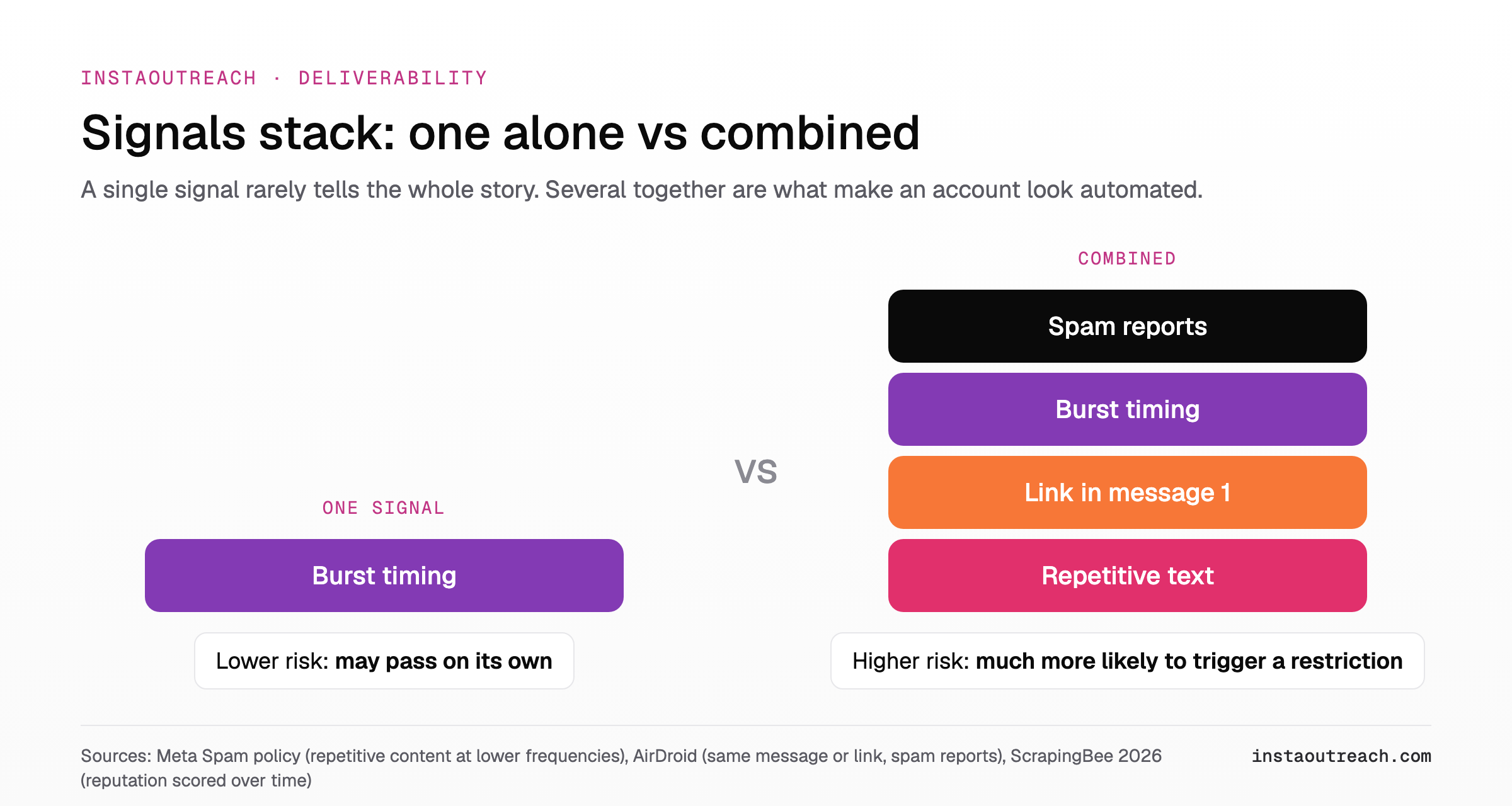
Signals also stack. A single one, say a 36-second gap, may pass. Repetitive text plus a link plus a burst plus two reports in an hour is a very different picture.
Audit your automation setup: a 7-signal checklist
Run this before you start a campaign and again after any warning. Each row is one signal, one check, one pass condition. If a row fails, fix it before you raise volume.
| # | Signal | Check | Pass condition |
|---|---|---|---|
| 1 | Identical text | Put 10 random sent openers side by side | No two share more than the greeting |
| 2 | Burst timing | Export send timestamps for one day | Random gaps, sends only inside set active hours, no fixed-interval line |
| 3 | Links | Read every step-one message | No link in message 1 |
| 4 | Sending path and typing | Ask the vendor how messages are sent | Runs in the real Instagram UI with typed input, not a private API |
| 5 | Browser traces | Ask the vendor whether the browser is driven by webdriver or CDP | No navigator.webdriver flag, no CDP traces |
| 6 | Login and session | Check Instagram's login activity screen | One login location, no password given to a third-party app |
| 7 | Reports and replies | Watch reply rate and Account Status daily | Pause the account on the first warning |
| Bonus | Account age | Check when the account first sent cold DMs | Warmup done on new accounts before the first cold DM |
Row 7 needs a note. After a messaging warning, Instagram's help pages say you "may not be able to send more direct messages for a period of time", and Meta says Account Status shows "some restrictions your account might have and how long they'll last" (both as quoted by CreatorFlow). If you already hit one, follow the action block recovery playbook before sending anything else.
Row 4 is the one you cannot fix with discipline; it depends on the tool. When you compare DM tools, look past features and ask how each one sends: private API, emulator or your own browser. Then weigh the cost of a tool on the pricing page against doing the volume by hand.
InstaOutreach is built around several of these signals (it drives the real Instagram interface in your own browser with human-paced typing, daily limits and active hours), which its FAQ says lowers the risk but does not remove it: automation is still against Instagram's terms.
FAQ
Can Instagram tell if I use a DM automation tool?
Often, yes, though Instagram does not explain how. Meta's spam policy says its detection "must constantly evolve" and covers activity done "manually or automatically, at very high frequencies." Some signals are documented, like repetitive content, high frequency and automated access without permission. Others, like typing rhythm, webdriver flags and session fingerprints, are inferred by vendors such as ScrapingBee. A private-API tool is the easiest to spot because it never touches the app interface. A tool that runs in a real browser leaks fewer signals, but no tool is undetectable, and the content you send (identical text, links) can flag you regardless of how it is sent.
Does sending the same DM to many people get you flagged?
It is one of the most likely triggers. Meta's spam policy lists "posting repetitive content" as an indicator that can lead to restrictions even at lower frequencies, and AirDroid names "sending the same message or link to lots of accounts in a very short period" as a common cause of messaging blocks. Swapping a word or two with spintax does not help much, because the structure, length and call to action stay the same. What changes the picture is a different reason for writing to each person, so the whole opening sentence differs from one recipient to the next.
Will DM automation trigger "We suspect automated behavior on your account"?
It can. Instagram's help pages, as quoted by CreatorFlow, list two relevant causes: "Your account is automating access to, or collecting information in an automated way without our permission," and giving "your username and password to a third-party app or website." A DM tool that logs in with your password or uses a private API matches both. Burst sending and identical messages add to it. The warning does not always come with a block, but treat it as the moment to stop sending, check Account Status and review the setup before resuming.
How many automated DMs can I send before Instagram flags me?
There is no official number. Instagram publishes no DM cap, and Meta's policy only refers to "very high frequencies." Counts you see online are self-reported by operators or vendors and vary with account age, history and content. Volume is also only one signal: an account sending a few dozen identical messages with links can get flagged faster than one sending more personalized ones at a steady pace. For the figures operators report and why they differ, see our post on the DM and action limits people report, and read every number there as a claim, not a rule.
Are links in Instagram DMs flagged as spam?
Links are not banned, but they raise risk in cold outreach. Meta's spam policy has a named rule against misleading links, and AirDroid lists sending the same link to many accounts in a short period as a messaging-block trigger. In a first message to a stranger, a link also looks like phishing and invites a spam report, which is a separate signal. The practical rule is to keep message one link-free, ask a question, and send the link only after the person replies and asks for it.
Is Instagram DM automation against the rules?
Yes. Instagram's Terms of Use say "You can't attempt to create accounts or access or collect information in unauthorized ways," and that this includes "accessing or collecting information in an automated way without our express permission, regardless of whether such automated access or collection is undertaken while logged-in to an Instagram account." Cold DM automation tools do not have that permission. Using one is a risk you take on your account, and no vendor can promise it will not be restricted.