Manual DMs Restricted on Instagram? Why Hand-Typed DMs Get Blocked
Sending 50 to 70 DMs a day by hand and still getting a 24-hour restriction? Instagram does not check whether you typed the message. It reads patterns and reports. How to read them and fix yours.
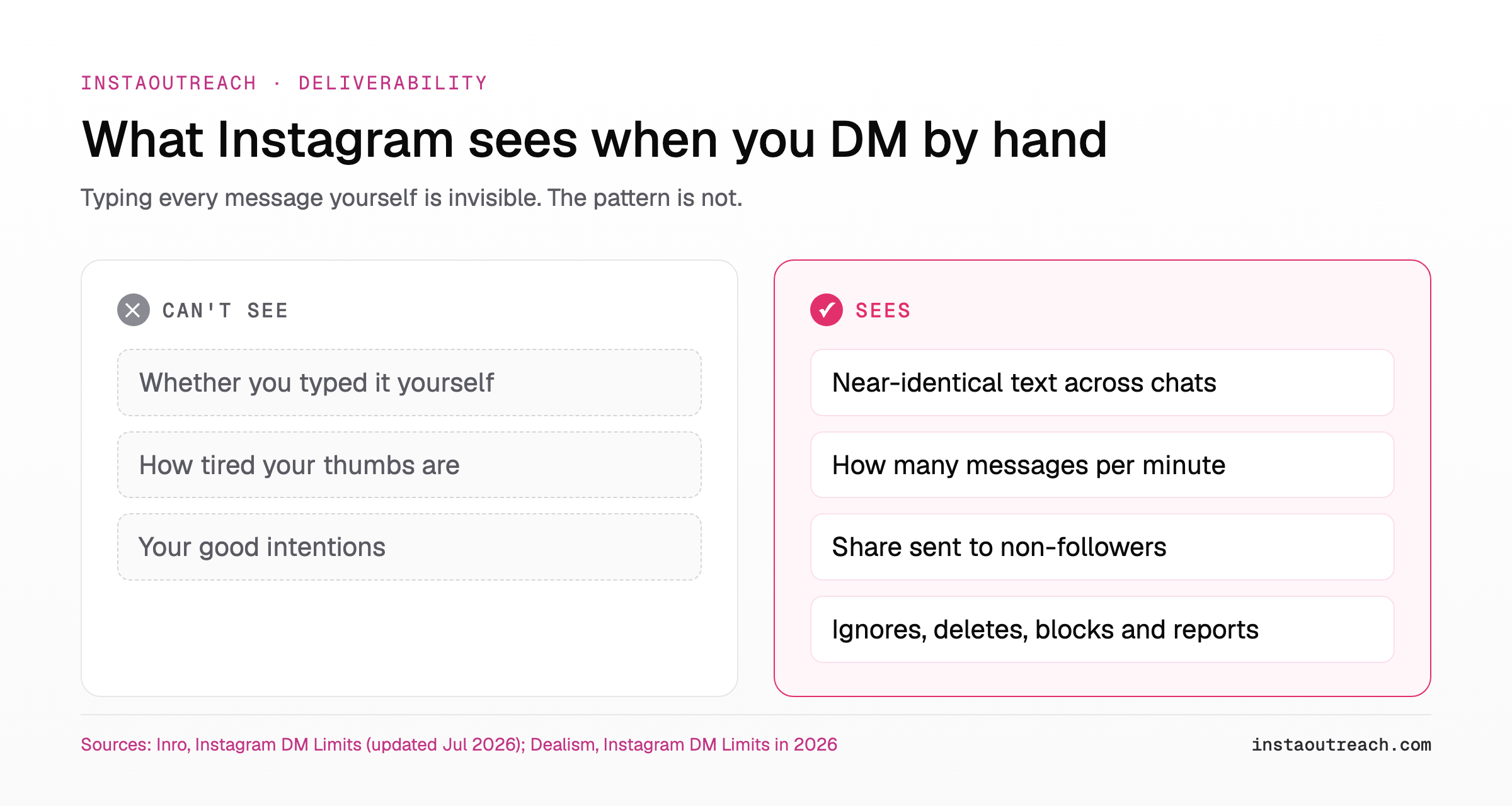
Yes, manual DMs on Instagram get restricted, because Instagram does not look for "a bot", it looks for patterns: near-identical text, bursts of sending, messages to strangers and how recipients react. Inro, a DM tool vendor, puts it in one line: Instagram "publishes no daily send limit" and "what actually triggers a block is the pattern, not the count" (Inro, 2026). Dealism makes the same point for manual senders specifically, listing who receives the messages, how quickly you send them and whether people report them as the variables that matter (Dealism, 2026).
So if you type 50 to 70 DMs a day by hand and still see "You can't send messages for 24 hours", the daily count is probably not the whole story. What those messages looked like to the system, and to the people who got them, is. This guide shows which signals a hand-sender still emits, gives you a self-audit checklist, does the arithmetic on reports, and lays out a 7-day plan after a restriction.
Why does Instagram restrict manual DMs if I'm not using a bot?
Instagram sees the output of your outreach, not your hands. Typing every message yourself removes one risk, the technical footprint a third-party tool can leave, but it changes none of the content and behavior signals that enforcement reads.
Inro names four patterns that "do most of the damage" (Inro, 2026):
- Repetition. Near-identical messages to many people are "the single strongest signal", and "swapping a first name does not count as varying the message".
- Speed. "Twenty messages in five minutes is treated very differently from twenty across an afternoon."
- Cold recipients. People who never interacted with you carry more risk, because "there is no prior relationship to justify the contact".
- How people react. "Ignored, deleted and reported messages accumulate against the account."
Dealism's list for manual DMs overlaps almost completely: the same or nearly identical text, a sudden burst unlike the account's normal behavior, many message requests to non-followers, and continuing after recipients ignore, block or report you (Dealism, 2026). Behind all of this sits Meta's Spam policy, one of the Community Standards that Meta says cover "Facebook, Instagram, Messenger and Threads".
None of those signals asks how the message was typed. A copy-pasted opener sent by thumb in a 20-minute burst to 60 strangers looks the same to the system as the same opener sent by a script.
Is 50 to 70 manual DMs a day too many?
There is no official answer, because Instagram does not publish a daily cap for manual DMs (Dealism, 2026). What exists are ranges vendors report from what they observe, and they are claims, not limits.
| Account type | What is reported | Source |
|---|---|---|
| Established account, clean history | "Somewhere around 50 to 100 before problems start" | Inro, 2026 |
| New account | "Often blocked after a couple of dozen messages in a day" | Inro, 2026 |
| Any account | No universal cap; depends on how conversations begin, who receives them, pace and reports | Dealism, 2026 |
Read the table the other way round. If 50 to 70 a day sits inside the range Inro calls normal for an established account, and you still got restricted, then the number was not what tripped you. Either the account is newer or less trusted than you think, or the messages carried one of the patterns above.
This post does not repeat the full limit tables. For those, see the numbers people report for DM and action limits. The useful question for a hand-sender is not "how many" but "which of my habits looks like spam".
Which manual DM habits look like spam?
Use this as a checklist. Go through your last week of sending and tick every row that describes you. Each ticked row is a signal you can remove without sending fewer messages.
| Habit (tick if this is you) | Why it reads as spam | Fix |
|---|---|---|
| Copy-paste opener, only the first name changes | Repetition is "the single strongest signal" and a name swap "does not count as varying the message" (Inro) | Write the first line from something specific to that profile; keep only the structure, not the sentences |
| All sends in one 20 to 30 minute block after work | Pace matters more than volume; a burst looks unlike normal behavior (Inro, Dealism) | Split the day into 3 or 4 short sessions with real gaps |
| Almost every recipient is a non-follower who never engaged | Cold recipients carry more risk; many message requests to non-followers is a listed risk pattern (Dealism) | Mix in people who follow you, replied to a story or commented |
| A link in the first message | "The same message or link to lots of accounts in a very short period" is a named trigger (AirDroid) | No link until the person replies and asks |
| Follow-ups to people who ignored you, again and again | Continuing after recipients ignore, block or report you is a risk pattern (Dealism) | One follow-up, then stop |
| Same pitch sent from several of your own accounts | The template stays detectable across chats (Inro) | Different angle per account, or fewer accounts |
| You never look at who blocked or deleted the chat | Ignored, deleted and reported messages "accumulate against the account" (Inro) | Track replies vs silence per list; drop lists that go silent |
Three or more ticks means your account emits most of the patterns a script would, just more slowly. The copy row is usually the cheapest to fix: start from openers you can rewrite per recipient instead of one paste-ready line. If your messages never even reach the inbox, read why cold DMs die in hidden requests before you change anything else.
How fast do reports add up at "safe" manual volume?
Faster than most hand-senders assume, because report count grows with volume no matter who typed the message. Reports are one of the signals both Inro and AirDroid name: being "repeatedly reported as 'spam' or 'unsolicited' by other users" is listed as a trigger (AirDroid), and reported messages "accumulate against the account" (Inro, 2026).
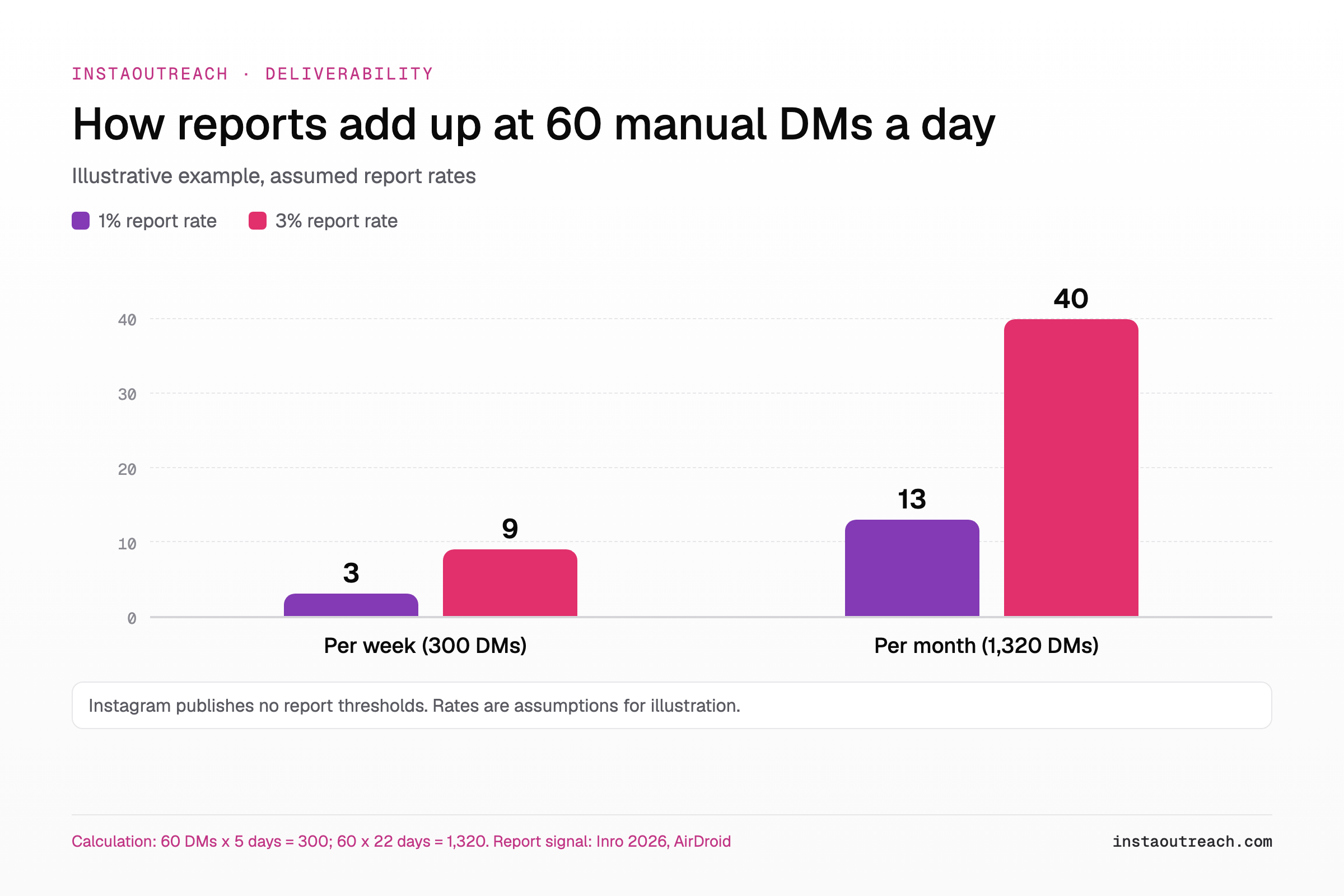
Example, assumed numbers: Instagram publishes no report rate or report threshold. The 1% and 3% below are assumptions chosen to show the arithmetic, not measured rates.
Worked example. You send 60 hand-typed cold DMs a day.
- Per week (5 sending days): 60 x 5 = 300 messages.
- Per month (22 sending days): 60 x 22 = 1,320 messages.
- If 1% of recipients tap report: 300 x 0.01 = 3 reports a week, 1,320 x 0.01 = about 13 a month.
- If 3% tap report: 300 x 0.03 = 9 reports a week, 1,320 x 0.03 = about 40 a month.
The point is not the exact figures. It is that a volume which feels modest, 60 a day, still produces a steady stream of negative reactions if the message is not welcome. Cutting the report rate, through better targeting and a first line that is clearly about the recipient, does more than shaving 10 messages off the daily count.
How long does a manual DM restriction last, and does it escalate?
A first restriction usually lasts about 24 hours, and repeat behavior tends to bring longer ones. AirDroid describes temporary restrictions of "24 hours, 3 days, or even 7 days", where "a 24-hour block is usually a first warning, while a 3-day or 7-day block often means Instagram thinks the behavior is repeating" (AirDroid).
Inro reports that "a first block usually clears on its own within a day or two" and that "you can still receive messages, you just cannot send" (Inro, 2026). Two more details matter for anyone who restarts right away: "retrying during a block can extend it", and after a multi-day block "accounts often operate under quietly reduced limits for a while afterwards" (same source).
One common confusion: articles about official-API messaging tools talk about a "24-hour messaging window". That is a rule about when a business may reply to someone who messaged it, and it is a different thing from a 24-hour restriction on your account. If your restriction is formally over but sending still fails, see a restriction that lingers after Meta says it's lifted. For the broader recovery steps, use the action block recovery playbook.
What to do in the 7 days after a 24-hour restriction
Stop, appeal once, and come back with fewer of the signals that caused it. The schedule below is an example, not a safe limit: Instagram publishes none, so the numbers are placeholders you scale to your own account.
- Stop sending and do not test. Retrying during a block "can extend it" (Inro, 2026).
- Appeal once. In the app: Settings > Help > Report a Problem (AirDroid). One clear report, not five.
- Fix the checklist rows you ticked above before the block ends.
- Come back lower and spread out, with a rewritten opener per recipient.
- Start warm. Prioritize people who follow you, replied to a story or commented. See warm entry through comments and story replies.
- Drop non-responders after one follow-up. More on that in how many follow-ups before you stop.
| Day | Sending | Focus |
|---|---|---|
| Day 1 | None | Do not test sending. Submit one appeal. Run the self-audit checklist. |
| Day 2 | None | Rewrite your opener so the first line is about the recipient. Remove links from first messages. |
| Day 3 | Replies only | Answer existing conversations. Like, comment and reply to stories on your target list. |
| Day 4 | A small batch, warm only | Message people who engaged with you. Spread across the day. |
| Day 5 | Small batch, mostly warm | Add a few cold recipients with a researched first line. |
| Day 6 | Slightly higher, spread out | Check replies vs silence. Drop any list that goes quiet. |
| Day 7 | Review | Count ignores and blocks. Only raise volume if replies held up and nothing new was restricted. |
If a second restriction arrives within days, treat it as the "behavior is repeating" signal AirDroid describes and slow down further rather than pushing through.
Manual vs a tool: does either protect your account?
Neither does. Typing by hand does not hide repetition, bursts, cold targeting or reports, and a tool does not either. Automating Instagram DMs is against Instagram's Terms of Use, so a tool adds its own risk on top of the pattern signals.
Bottom line: Restrictions follow what your messages look like and how people react to them. Fix copy and targeting first; the sending method comes second.
What changes between the two is who enforces the discipline. A tool can hold pacing, daily caps and active hours steady on days you would break them because you are tired or behind. It cannot write a first line someone wants to read, and it cannot choose better recipients for you.
| Factor | Manual sending | Tool |
|---|---|---|
| Pace (gaps between messages) | Depends on your discipline that day | Can be enforced by settings |
| Daily cap | Easy to overshoot on a busy day | Fixed number you set |
| Active hours | Often one burst after work | Can be spread across set hours |
| Copy quality | Up to you | Still up to you |
| Targeting | Up to you | Still up to you |
| Terms of Use risk | Pattern signals only | Pattern signals plus automation, which Instagram's terms prohibit |
If you do compare tools, look first at where they run, since that changes your exposure: the comparison of outreach tools lays out the differences, and pricing per account shows the cost before you commit. InstaOutreach runs in your own browser through a Chrome extension or the Mac app, sends within daily limits you set, and stops when the browser or app is closed (pricing).
FAQ
Can you get restricted on Instagram for sending DMs manually?
Yes. Instagram's enforcement reacts to patterns, not to whether a person or a program typed the message. Inro lists repetition, speed, cold recipients and recipient reactions as the four patterns that do most of the damage, and says the pattern matters more than the count (Inro, 2026). Dealism lists the same risks for manual DMs: nearly identical text, sudden bursts, message requests to non-followers, and continuing after people ignore or report you (Dealism, 2026). A hand-typed copy-paste campaign to strangers emits every one of those signals.
How many manual DMs can I send per day without getting restricted?
Instagram publishes no daily cap for manual DMs, so no number is "the limit" (Dealism, 2026). Vendors report ranges from what they observe: Inro says established accounts with a clean history sit "somewhere around 50 to 100 before problems start", while new accounts are "often blocked after a couple of dozen messages in a day" (Inro, 2026). Treat those as rough observations. Pace, repetition, who you message and how they react matter more than staying under any number.
How long does "You can't send messages for 24 hours" last, and can it get longer?
The first one usually lasts about a day. AirDroid describes restrictions of 24 hours, 3 days or 7 days, with 24 hours usually a first warning and the longer ones a sign Instagram thinks the behavior is repeating (AirDroid). Inro reports a first block usually clears within a day or two, that you can still receive messages while blocked, and that accounts often run under quietly reduced limits after a multi-day block (Inro, 2026).
Does sending the same message to many people get you restricted?
It is one of the strongest triggers. Inro calls near-identical messages to many people "the single strongest signal" and says swapping a first name does not make a message different, because the underlying template is still detectable (Inro, 2026). Dealism notes that repeated identical messages "can resemble spam, especially when recipients did not request them" (Dealism, 2026). AirDroid lists sending the same message or link to lots of accounts in a short period as a restriction trigger. Rewrite the opening line for each recipient.
Should I keep trying to send during a restriction?
No. Inro warns that retrying during a block can extend it, and advises stopping rather than testing whether it has lifted (Inro, 2026). Use the time instead: submit one appeal, run through your copy and targeting, and plan a slower, spread-out restart that starts with people who already engaged with you. Testing every few hours mostly adds more failed attempts to the account's record and delays the point where you can send normally again.
Can I appeal a DM restriction?
Yes. In the Instagram app, go to Settings > Help > Report a Problem and describe what happened (AirDroid). Send one clear, factual report rather than several: repeated appeals do not speed anything up. An appeal is worth doing, but plan as if the restriction will simply run its course, and use those hours to fix the habits that caused it so the next one does not arrive a few days later at a longer length.