Find the Decision Maker Behind an Instagram Business Page
Sending 100 DMs a day to brand pages and hearing nothing? The page inbox is often read by staff or an agency. Here is how to find the person who decides, by company size, and what to send them.

At a small business, DM the owner's personal account, not the brand page; at a mid-size brand, DM the marketing lead, and if an agency runs the page, treat the agency as a gatekeeper, not the buyer. To find the decision maker on Instagram, you rarely need paid tools: the owner's handle usually sits in public clues on the page itself (bio mentions, tagged posts, comment replies, the website's About page), and a lookup capped at two minutes is usually enough for owner-run pages (our estimate, not measured data).
That routing rule is the fix for the most common complaint in agency outreach: "I send 100 business pages a day and nobody notices." The messages are often fine. They are going to an inbox that is read by someone who is paid to filter, not to buy.
Below: who reads the brand inbox at each company size, a 7-clue lookup checklist with a stop rule, a role matrix for bigger brands, three message frames, a worked example of volume versus routed DMs, and a lead-sheet template that keeps brand and owner mapped.
Should you DM the brand page or the owner?
DM the person, and use the brand page only as a fallback. A brand inbox is a shared queue. At a one-person shop the owner reads it between client work; at a 30-person company it is read by a social media coordinator, a virtual assistant or an agency whose job is to answer customers and delete pitches.
The good news for SMMA operators: most pages you hit are owner-sized. According to the SBA Office of Advocacy, 99.9% of US businesses are small, there are 34,752,434 small businesses in the United States, and they employ 45.9% of American workers. Most salons, clinics, gyms, coaches and local shops you target fall in that group, where one person both signs the check and posts the stories.
Inro makes the same point from the channel side: a great deal of the small-business, local and creator world is barely on LinkedIn at all, which makes Instagram the realistic way to reach them. So the job is not "find them on LinkedIn first". It is "find the human behind the logo on Instagram".
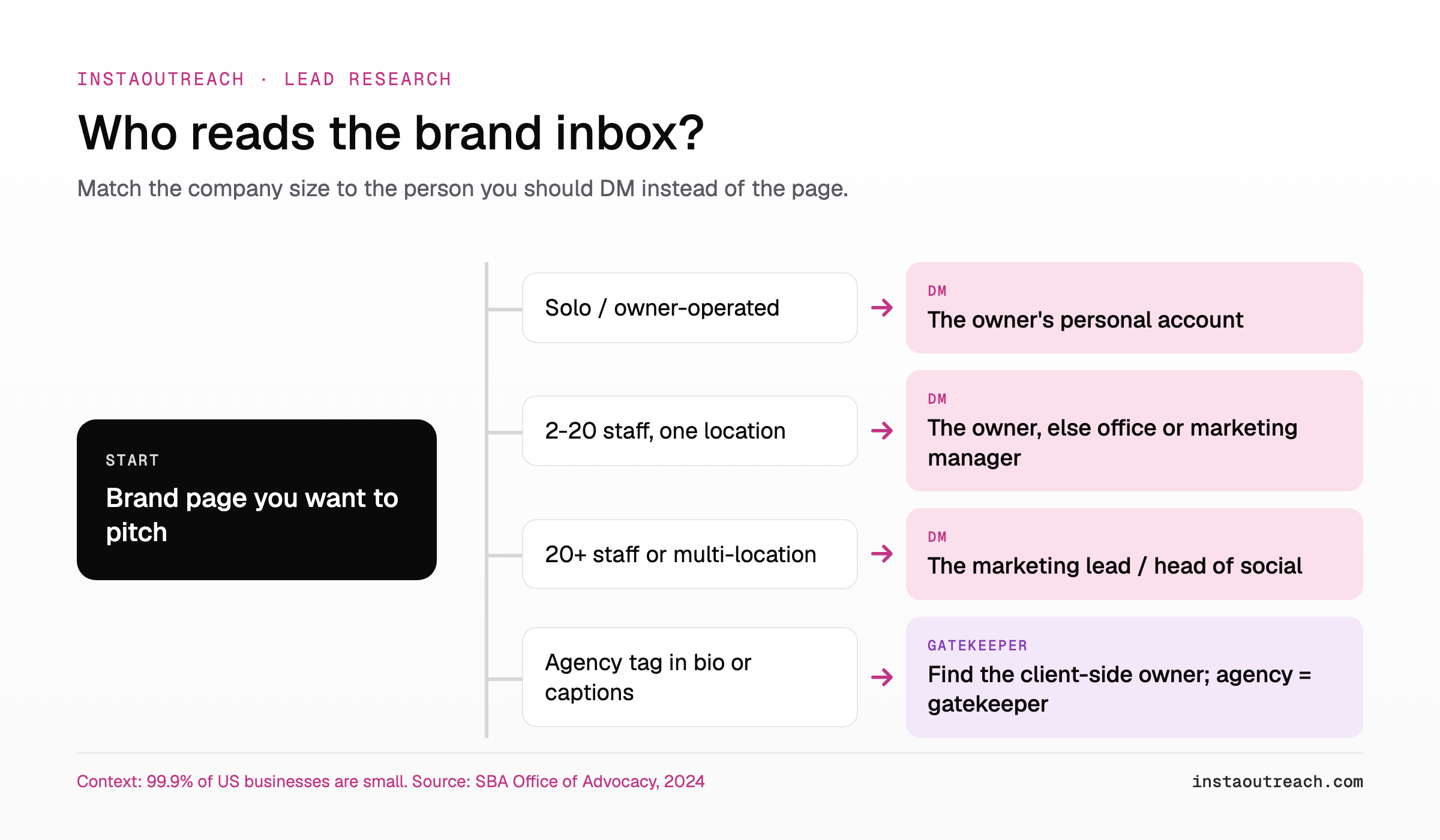
Use this routing rule before you write a single word:
- Solo or owner-operated (owner's face in most content, first-person captions): DM the owner's personal account.
- 2 to 20 staff (team photos, "our team" posts, one location): DM the owner first; if the owner is invisible, the office or marketing manager.
- 20+ staff or multi-location (several location tags, polished campaign content): DM the marketing lead, head of social or partnerships lead.
- Agency-run page (agency tagged in bio or captions, uniform templated posts): find the client-side owner; the agency is a gatekeeper with a retainer to protect.
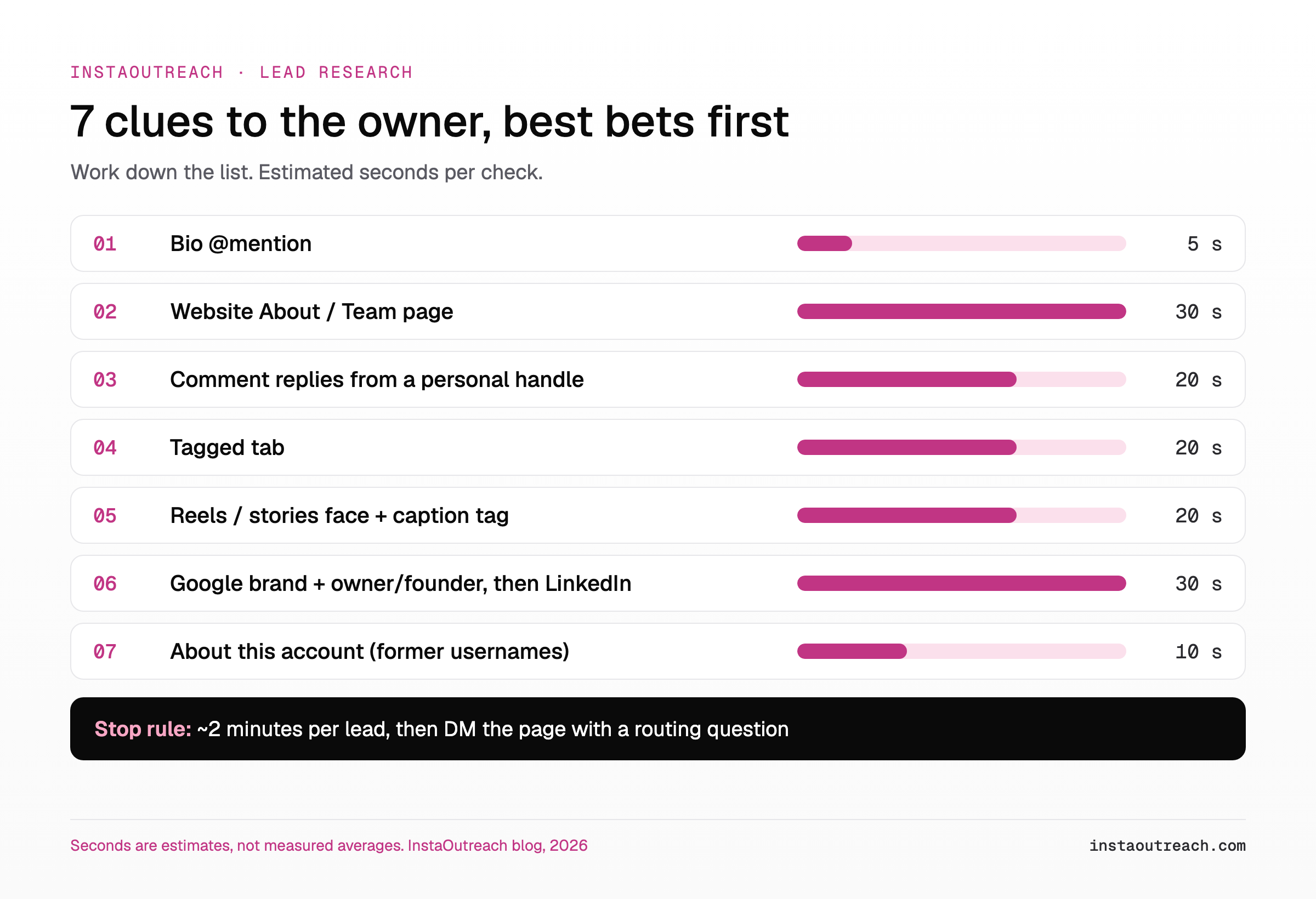
How to find the owner of an Instagram business account (7 public clues)
Work through these clues in order, highest hit rate per second first, and stop the moment you have a confident match. The seconds below are our estimates for an experienced researcher, not measured averages; your own times will vary by niche.
- Bio @mentions (est. 5 seconds). "Founded by @...", "Owner: @...", "Book with @..." is the fastest hit. Many owners put themselves in the brand bio because it builds trust with customers.
- Linked website About or Team page (est. 30 seconds). Open the link in bio. Small business sites usually name the founder, often with a photo you can match to an Instagram face. Search the name plus the brand on Instagram.
- Comment replies from a personal handle (est. 20 seconds). Open the last 3 posts with comments. Owners often reply from their own account ("Thank you so much, see you Thursday!"), and that account usually has the brand in its bio.
- Tagged tab (est. 20 seconds). The tagged photos tab shows who tags the brand. The owner tends to appear repeatedly, often at events, openings or behind the counter.
- Reels and stories with a face plus a caption tag (est. 20 seconds). If the same person talks to camera in most Reels, the caption or on-screen text frequently tags them. Story highlights such as "About us" or "Meet the team" are worth one tap.
- Google the brand plus "owner" or "founder", then LinkedIn (est. 30 seconds). Local press, podcast guest pages and directory listings name owners. Take the name back to Instagram search.
- "About this account" for context (est. 10 seconds). Instagram's account info panel can show basic history such as the join date and, for some accounts, former usernames. It will not name the owner, but a former username that looks like a person's name, or a recent rename, is a useful hint.
Stop rule: cap research at about 2 minutes per lead. You will rarely need all seven; most matches come from the first two or three checks. If nothing matches by then, DM the brand page with a one-line routing question (frame 3 below) and move on. Lookups also cost profile views, so keep the hidden cap on profile views during lead research in mind before you open 15 profiles per lead.
Check before you send: a match needs two signals, not one. Example: the bio says "founder of @brand_example" and the brand's comment replies come from the same account. One weak signal (a single tag) can be a customer or a friend.
Who decides at mid-size brands and multi-location businesses?
Above roughly 20 people, the owner stops reading DMs and the buying decision splits across roles. The person who reads the page inbox is usually not the person who controls budget. Pitch the role that recommends and the role that signs, and treat the rest as gatekeepers you route through politely.
| Role | Decides budget? | Reads page DMs? | What to pitch | Risk |
|---|---|---|---|---|
| Owner / founder | Yes | Rarely at this size | Revenue, booked customers, time back | Hard to reach; DM may sit in requests |
| Marketing manager / head of marketing | Recommends, sometimes owns a budget line | Sometimes | Pipeline, results they can report upward | Busy; needs a short, specific ask |
| Social media coordinator | No | Yes, daily | Saved hours, content that makes them look good | Paid to filter pitches; may never forward |
| Agency running the page | No (client decides) | Yes | Complementary service, not a replacement | Protects its retainer; may block you |
| Location manager (multi-site) | Small local budget at most | For a location page, yes | Local foot traffic, staff time | Often must escalate to head office |
For mid-size brands, the marketing lead is usually the best first DM: close enough to the problem to care, senior enough to forward to whoever signs. Find them with the same clues as above, plus the team page and LinkedIn titles such as "Head of Marketing", "Social Media Manager" or "Partnerships".
What to send the owner vs the social media manager vs the agency
Change the angle, not just the name. An owner buys outcomes; a manager buys looking good and saving time; a brand inbox needs a question that is easy to answer and easy to forward. Fill in the brackets with something you actually saw on their account; never invent a result.
Template (owner): Hey [first name], saw [specific thing: new location, the Reel about X]. I help [type of business] turn [their channel] into [outcome they care about: booked consults, table reservations]. Open to a 2-line idea for [brand]? No call needed.
Template (marketing or social media manager): Hi [first name], liked how [brand] handled [specific post or campaign]. I work with [type of business] on [the part of their job you take off their plate]. Want me to send one example you could show [owner or boss] this week?
Template (brand page fallback): Hi [brand] team, quick question: who handles [marketing / partnerships / new suppliers] there? Happy to send a short note their way instead of filling this inbox.
The fallback works because it asks for routing, not a meeting, and the person reading the page can answer in one word. For the line-by-line structure behind the first two frames, see this line-by-line teardown of a high-reply DM. Your sending account matters too: check whether your own business account hurts DM visibility before you scale.
Some practitioners argue that personal sender accounts get better cold reply rates than business accounts, for example Lilach Bullock. Treat that as one view and test it on your own list.
Worked example: 100 brand pages a day vs 40 owner DMs
This is an example with assumptions, not a benchmark. Instagram publishes no official DM cap and no public reply-rate data, so plug in your own numbers once you have them.
Assumptions (example only):
- Plan A: 100 DMs a day to brand pages, no research. Assume 25% of those messages reach someone who can decide (owner-run pages), the rest are filtered by staff or an agency.
- Plan B: 40 DMs a day to owners or marketing leads, 2 minutes of research each (40 x 2 = 80 minutes). Assume 90% reach a decision maker (some matches are wrong).
- Same message quality in both plans. Assume 6% of decision makers who receive it reply with interest.
Arithmetic:
- Plan A: 100 x 25% = 25 decision makers reached. 25 x 6% = 1.5 interested replies a day.
- Plan B: 40 x 90% = 36 decision makers reached. 36 x 6% = 2.16 interested replies a day.
Plan B wins with 60% fewer messages and 80 minutes of research. There is one honest caveat: an owner's personal account has no reason to follow you, so your DM lands in message requests, which many people open late or never (see why cold DMs land in hidden requests). If that drags the owner reply rate from an assumed 6% down to 4%, Plan B gives 36 x 4% = 1.44, roughly a tie with Plan A, at a much lower send volume per account.
The lever is not volume. It is the share of messages that reach someone who can say yes.
How to keep brand-to-owner mapping in your lead list
Store the person and the brand on the same row, so you never DM both the page and the owner on the same day and look like a bot. Use a sheet like the one below (fictional handles).
| Brand handle | Person handle | Role | Clue found | Date checked | Status | Do not contact |
|---|---|---|---|---|---|---|
| @brand_example | @jane_owner_example | Owner | Bio @mention + comment replies | 2026-11-01 | DM sent | No |
| @clinic_example | @mark_mktg_example | Marketing lead | Website team page | 2026-11-01 | Queued | No |
| @gym_example | (not found) | Page fallback | 2-min cap reached | 2026-11-01 | Routing question sent | No |
| @salon_example | @owner_salon_example | Owner | Tagged tab | 2026-10-28 | Said no | Yes |
Rules that keep the list clean:
- One touch per company per day. Owner or page, never both.
- Owner replies, page stops. Any reply from the person ends outreach to the brand inbox.
- A "no" is company-wide. Mark the whole row do-not-contact, not just the handle that answered.
- Re-check after 90 days. Staff and agencies change; refresh the "date checked" column before a new campaign.
Where the leads come from is a separate decision: start with ranking lead sources by intent, then plan the second and third touch with a sensible follow-up cadence. If the owner never opens requests, an email fallback in a two-channel sequence is the next step.
If you send at scale with software, know that automating Instagram DMs is against Instagram's Terms of Use, and no tool can promise an account stays safe. To pick a tool, compare every Instagram DM tool in one table, and check cost per account before you add senders. InstaOutreach imports a CSV or pasted handles into up to ten custom fields, so the brand and person columns carry over, and its do-not-contact mark blocks re-contact across every campaign. It runs in your own browser (Chrome extension or Mac app) and only while that browser is open.
FAQ
How do I find the owner of an Instagram business account?
Start with the brand's bio, where owners often tag themselves ("founded by @..."). Then open the website in the bio and look for an About or Team page that names the founder. Check who replies to comments from a personal account, and scan the tagged tab for a face that appears again and again. If that fails, search the brand name plus "owner" or "founder" on Google and LinkedIn, then return to Instagram search with the name. Look for two matching signals before you send, and cap the lookup at about two minutes per lead.
Should I DM a business page or the owner's personal account?
At a small, owner-operated business, DM the owner's personal account: the page inbox is shared, often read late, and filled with customer questions. At larger brands, DM the marketing lead instead of the page, because the page inbox is usually handled by a coordinator or an agency. Use the brand page only as a fallback, with a one-line question asking who handles marketing or partnerships. Never message both the page and the owner on the same day, since it reads as spam and wastes your one shot.
Who usually manages a brand's Instagram DMs?
It depends on size. At a solo business or a small team, the owner usually answers DMs personally, sometimes with help from one staff member. At mid-size brands, a social media coordinator or community manager reads the inbox daily and answers customers. Multi-location businesses may split pages by location, each run by a local manager. Many brands also hand their account to an outside agency, which then reads every DM. In all the larger cases, the person reading the inbox is rarely the person who decides on budget.
How do I find a decision maker without LinkedIn?
Use the Instagram account itself. Bio mentions, comment replies, the tagged tab, Reels where the same person speaks to camera, and story highlights such as "Meet the team" all point to the people behind a brand. The website in the bio adds names and photos you can match. Local press, podcast guest pages and directory listings often name owners when LinkedIn does not. For small and local businesses this is the normal route, since many of them are barely active on LinkedIn at all.
Is it creepy to DM a business owner's personal Instagram?
Not if you keep it about the business. Use only public, business-related information: their brand, their posts, their role. Send one relevant message, and accept a "no" or silence without chasing. Do not reference family photos, private accounts or anything unrelated to their work, and do not dig through old personal content to make a point. Many owners run their personal account partly as a business channel, which is why the brand bio links to it. Mark anyone who declines as do-not-contact.
What if an agency runs the brand's Instagram?
Treat the agency as a gatekeeper, not the buyer. Its job is to protect the client and its retainer, so a pitch that competes with its service will likely be ignored or blocked. Find the client-side owner or marketing lead using the usual clues and DM them directly. If your offer complements what the agency does (for example a service it does not provide), you can mention that you are happy to work alongside the current team. Never criticize the agency's work to win the conversation.