Best Accounts to Cold DM: The Follower-Count Sweet Spot
Which Instagram accounts actually answer cold DMs? The 1k-20k follower claim tested against public data, why big inboxes go silent, and a way to find your own sweet spot.

The best accounts to cold DM are usually small-to-mid accounts still run by the owner, roughly the low thousands up to a few tens of thousands of followers, because big accounts have staff or managers filtering the inbox and tiny ones often have no budget. Treat that as a working hypothesis, not a benchmark: it comes from a thread on r/GrowthHacking that names 1k-20k as the sweet spot, and the best public data is one 2022 study that only contacted accounts above 10K followers: the 10K-50K tier, the smallest it tested, reached an almost 40% success rate and success fell as follower count rose (University of Novi Sad, 2022).
This post is about the size of the account you message. If you want to know how your own follower count changes where your message lands, that is a different question, covered in how your own follower count affects message requests.
We could not test this on our own send logs at a publishable sample size, so treat the bands below as a hypothesis to test in your niche. The last two sections give you the test plan and the tracking table to do it.
Which accounts are best to cold DM on Instagram?
Start with the claim and then weigh what backs it. A thread on r/GrowthHacking argues that accounts with roughly 1k to 20k followers reply most: big accounts have staff running the inbox, and very small ones have no budget to buy anything. We could not open the thread to verify it (Reddit blocked the fetch), so it stays attributed and unquantified.
The public evidence that touches recipient size is thin. Here is everything we found, ranked by how much it actually proves about cold DM replies.
| Source | Sample | What was measured | What it proves about DM replies |
|---|---|---|---|
| University of Novi Sad study, 2022 | 116 influencers with 10K+ followers, one small brand | Reply and acceptance of an unpaid DM collaboration offer, by follower tier | Direct but small. Real DMs, real replies, one brand and one offer type. |
| Ordinal engagement dataset | 70,322 Instagram posts since 2024 | Median post engagement rate by follower bucket | Indirect. Shows where audience attention peaks, says nothing about inboxes. |
| r/GrowthHacking thread | Unknown, one operator's experience | Claim that 1k-20k accounts reply most | Hypothesis only. Unverified, no published counts. |
Read the ladder from the top. One small study agrees with the top half of the claim (reply success falls above 10K) but never tested accounts under 10K, and one large engagement dataset is consistent with a mid-size peak. That is enough to design a test around, not enough to quote as a rule.
Do smaller Instagram accounts reply to DMs more?
Often, yes, and the reason is mostly about who reads the inbox. A cold DM from someone the recipient does not follow lands in Message Requests, "a folder that is not marked as read until they accept and that many people never open" (Inrō). Messages with no prior interaction or templated text can be pushed further into Hidden Requests, which people open even less (Inrō).
Now add follower count on the receiving side. A bigger audience means more strangers writing in, so each request competes with more noise. At some size the owner stops reading requests personally and a VA, a manager or an agency takes over, and their job is to filter, not to say yes to cold pitches.
At the other end, an account with a few hundred followers is usually run by the owner, who will see your message, but may not have the revenue to pay for a service. The sweet spot is the band where the owner still reads the inbox and the business is big enough to buy.
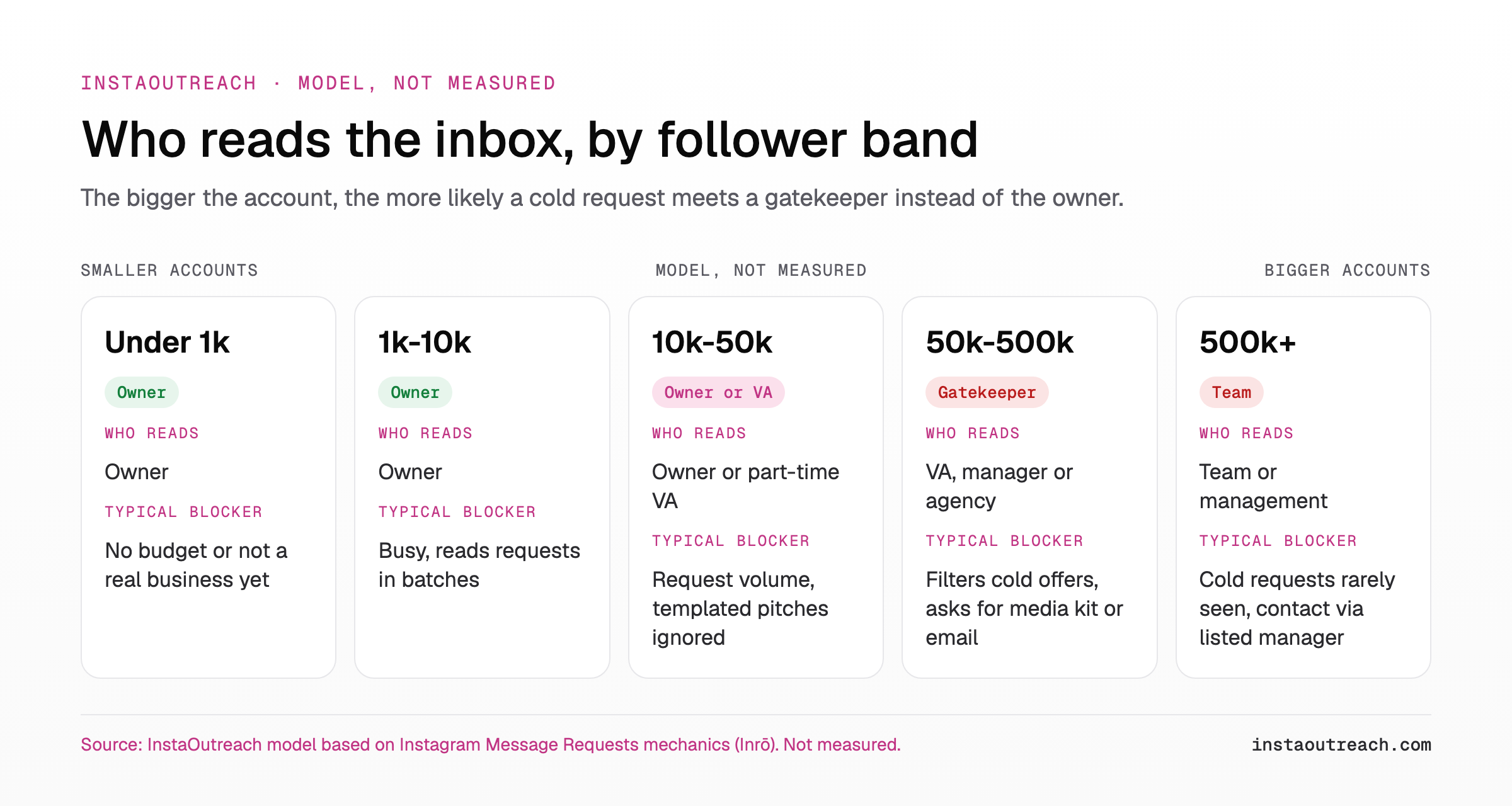
Note: This band model is a reasoning tool, not measured data. The thresholds are where the job of reading DMs tends to change hands, and they will shift by niche.
What the data says about follower count and response rate
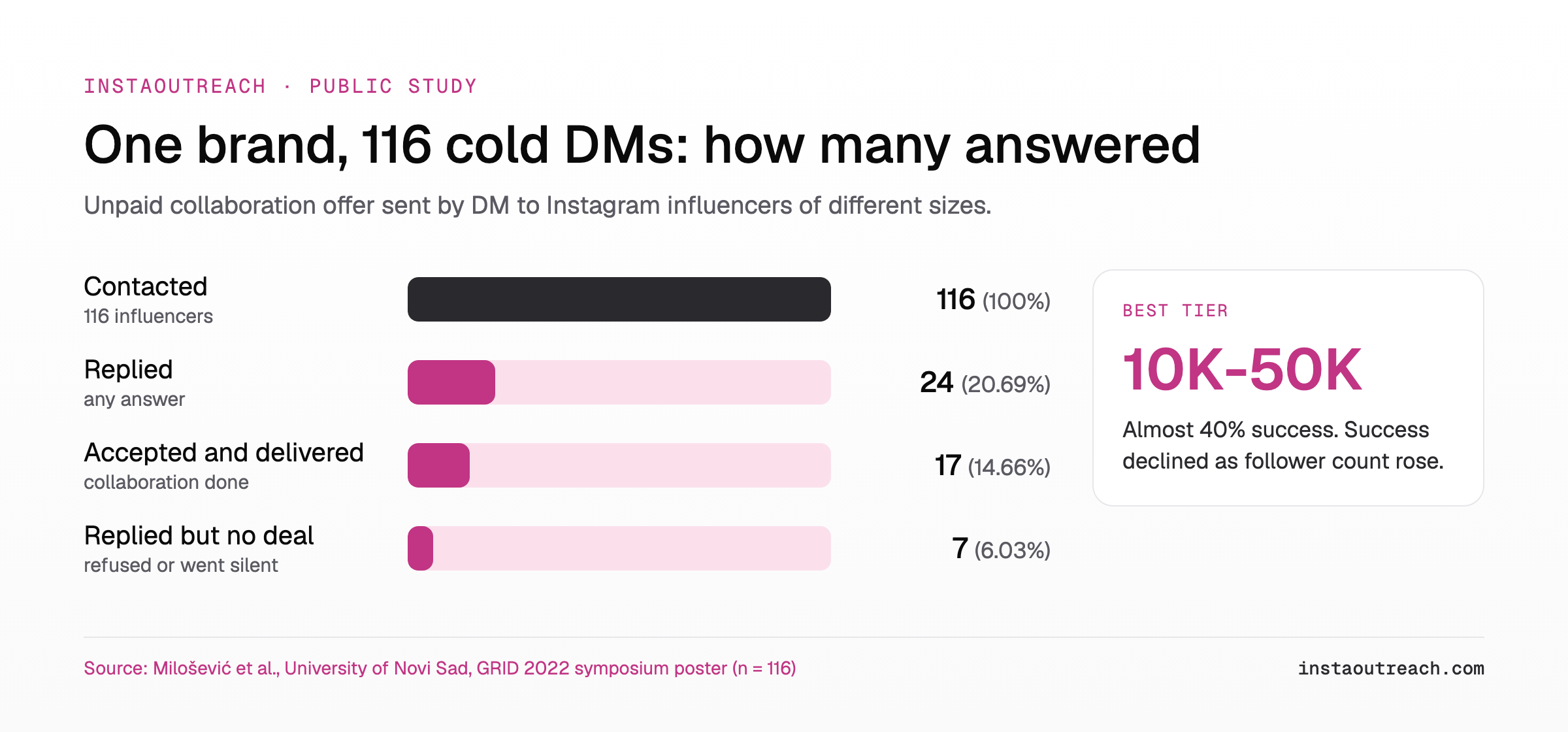
The only dataset we found that measures DM replies by recipient size is a 2022 poster from the University of Novi Sad. A small brand messaged 116 Instagram influencers of different follower counts with an unpaid offer: a free product (a pet portrait) in exchange for a feed post (University of Novi Sad, 2022).
The funnel looked like this, per the study:
- 20.69% (24 influencers) responded to the outreach.
- 14.66% (17 influencers) accepted and fulfilled the collaboration.
- 6.03% (7 profiles) replied but refused, asked to change the offer a lot, or went silent on follow-ups.
By tier, the 10K-50K micro-influencer group had the best result, "an almost 40% success rate", and the authors report "a clear declining trend in outreach success rate" as follower count rose (University of Novi Sad, 2022).
Before you build on it, know the caveats:
- Tiny bucket. The 10K-50K group was 9.48% of 116 contacts, which is about 11 accounts (116 x 0.0948 = 11). Almost 40% of 11 is roughly 4 collaborations.
- One brand, one offer. An unpaid product swap is not a B2B pitch for an agency retainer.
- Edges untested. The brand skipped nano-influencers (under 10K followers) and mega-influencers (over 1M), so the study says nothing about accounts under 10K, which covers most of the 1k-20k band from the Reddit claim.
- Success means acceptance, not just a reply.
- Age. Outreach ran from mid-2021 to early 2022, before several inbox changes.
Read it as one directional data point that agrees with the Reddit claim, not as proof.
Is engagement rate the same as reply rate?
No. Engagement rate measures how an audience reacts to posts. Reply rate measures whether the account owner answers you. They can move together, but one does not prove the other.
Still, engagement data shows where attention concentrates. Ordinal looked at 70,322 Instagram posts published since 2024 and found "engagement rate doesn't scale linearly with audience size" (Ordinal). Its medians, with engagement defined as likes, comments, saves and shares divided by impressions:
- Under 1K followers: 2.67%
- 1K-5K: 2.97%
- 5K-10K: 3.32% (across 4,866 posts)
- 10K-50K: 2.80%
- 50K+: 2.13%, but the highest average impressions at 52,725 per post
All figures from Ordinal.
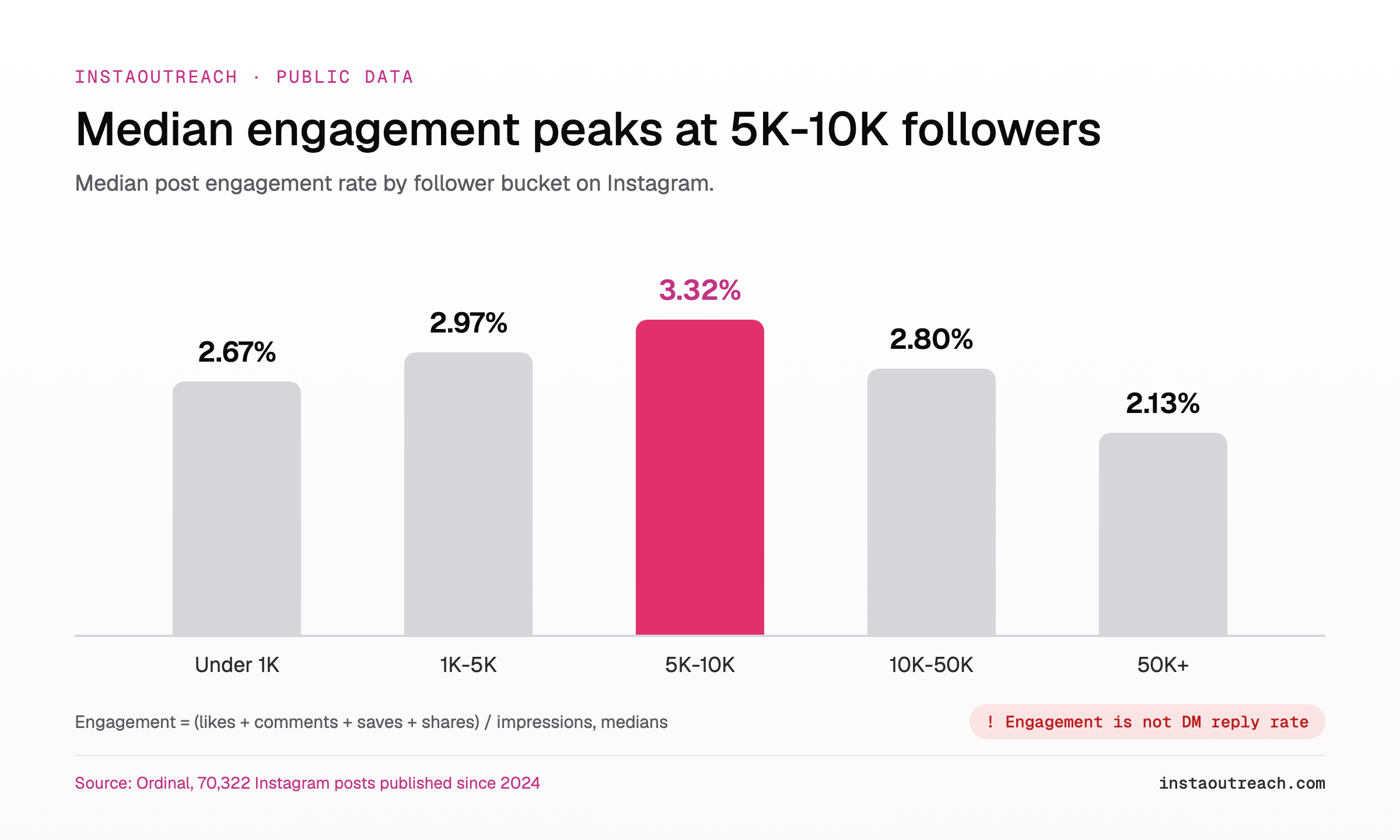
The shape is consistent with the sweet-spot hypothesis: attention peaks in the low thousands to ten thousand range and falls off above 50K. Use it as a supporting signal when you choose which bands to test, not as a reply forecast.
How to find the follower-count sweet spot in your niche
The honest answer to "best accounts to cold DM" is: the band that replies best for your offer, measured on your list. Here is a test protocol you can run in a couple of weeks.
The protocol
- Pull one lead list from a single source (for example one competitor's followers) so lead quality is similar across bands.
- Record follower count for every lead at the time you pull it.
- Split into 3-4 bands. Suggested: under 1k, 1k-10k, 10k-50k, 50k+. Add a 1k-20k cut if you want to check the Reddit claim directly.
- Keep everything else fixed. Same message, same follow-up, same sender accounts, same days and hours.
- Randomize send order so no band gets all the Monday mornings.
- Measure reply rate as unique accounts that replied divided by unique accounts successfully contacted, and report positive replies separately, the definition MySocial uses. A "no" counts as a reply. A follow-up does not count as a new contact.
- Track bookings per band, since a band with fewer replies can still produce more calls.
- Decide on volume, not vibes. Small differences on small samples are noise. Check the numbers in sample sizes for cold DM tests before you call a winner.
Worked example (hypothetical, with stated assumptions). Say you test 4 bands with 150 DMs each: 4 x 150 = 600 DMs. Assume each sender account runs at a default of 40 DMs a day, the default in one tool's settings (InstaOutreach FAQ). That is 600 / 40 = 15 account-days. With 3 sender accounts, the test takes 15 / 3 = 5 sending days, plus a few days for late replies.
Use this tracking table. Fill one row per band and compute the two rates at the end.
| Band | Delivered | Replied | Positive | Booked | Reply % | Positive % |
|---|---|---|---|---|---|---|
| Under 1k | Replied / Delivered | Positive / Delivered | ||||
| 1k-10k | Replied / Delivered | Positive / Delivered | ||||
| 10k-50k | Replied / Delivered | Positive / Delivered | ||||
| 50k+ | Replied / Delivered | Positive / Delivered |
Tip: Add a "booked per 100 delivered" column if your bands differ a lot in deal size. It is the number that decides where your next 1,000 DMs go.
When big or tiny accounts are still worth a DM
Low reply rate does not mean low value. The same 2022 study that favored 10K-50K also advised small businesses not to aim only at micro accounts, "but also toward the macro-influencer category (100K-500K followers)" (University of Novi Sad, 2022). One yes from a big account can outweigh ten from small ones.
Big accounts. Do not pitch the inbox, find the person behind it. MySocial's advice is short: "If a manager is listed, contact that representative" (MySocial). Check the bio, the contact button and the linked site before you write.
Tiny accounts. They are fine when your offer fits their budget, for example a low-ticket service or a product swap. Qualify by signals, not size alone: a real business address, a booking link, recent posts, ads running. The intent-ranked sources in targeting sources ranked by intent help here.
Narrow bands burn faster. If you only message 1k-20k accounts in one niche, you exhaust that pool sooner. Watch for the signs your niche list is burning out and widen the band before reply rates sag.
Rule of thumb: Default to owner-run accounts in the band your test wins, route big accounts to their manager, and only DM tiny accounts when your price fits a tiny business.
| Band | Verdict | How to adjust |
|---|---|---|
| Under 1k | Adjust | Only with a low-ticket offer and clear business signals |
| 1k-10k | Go | Personalize to their recent posts; owner usually reads it |
| 10k-50k | Go | Sharper first line, the inbox is busier |
| 50k-500k | Adjust | Contact the listed manager or email; DM as a second touch |
| 500k+ | Skip cold DM | Use management contacts or a warm intro |
Building a size-banded lead list
To run the test, follower count has to travel with every lead. Pull leads from a source with consistent quality, such as a competitor's follower list or a hashtag, and store the follower count as a field you can filter on later.
A practical setup:
- Source. One competitor's followers per test, so bands differ by size, not by intent.
- Band field. Store the band (for example "10k-50k") in a custom field, not the raw count only, so you can filter on it.
- Baseline. Compare your band results against the ranges in Instagram cold outreach benchmarks for 2026 to see whether the whole list is weak or just one band.
- Then optimize copy. Once you know which band to target, use the ways to raise reply rate without sending more on that band only.
Tool choice matters mostly for cost per test. Prices run from $29/mo to $99/mo per account on our comparison page, so check the side-by-side and the current pricing before you commit a test budget. Keep in mind that automating Instagram DMs is against Instagram's Terms of Use, whatever tool you pick, so keep volumes moderate. If you run the test with InstaOutreach, it works in your own browser via a Chrome extension or Mac app, supports competitor-follower and hashtag sourcing with up to ten custom fields per lead, and stops when the browser or Mac app closes (pricing).
FAQ
Do smaller Instagram accounts reply to cold DMs more often?
Often, up to a point. Small and mid-size accounts are usually run by the owner, who sees requests personally, while big accounts hand the inbox to staff or managers who filter cold pitches. The one study we found that measured this, a 2022 University of Novi Sad poster with 116 contacts, saw the best results in the 10K-50K tier among accounts above 10K followers and a decline as follower count rose. Very small accounts may read your message but lack the budget to buy. Treat the pattern as a hypothesis and test it on your own list with the same message across size bands.
What follower count is best for cold DM outreach?
There is no proven universal number. A thread on r/GrowthHacking argues for 1k-20k followers, and a small 2022 study found its best acceptance in the 10K-50K tier, the smallest it tested, about 11 accounts in that bucket. Engagement data from Ordinal on 70,322 posts peaks at 5K-10K, which points the same way but measures post reactions, not replies. The best count for you depends on offer price and niche. Split one list into 3-4 bands, send the same message, and compare reply rate and bookings per band before committing.
Why don't big Instagram accounts answer DMs?
Mostly volume and gatekeeping. A DM from a non-follower lands in Message Requests, which many people never open, and spam-looking messages can be moved to Hidden Requests. A big account receives far more of those requests, so the owner often stops reading them and a VA, manager or agency filters the inbox instead. Their job is to protect the owner's time, so cold offers rarely get through. If a manager or business email is listed in the bio, contact that person directly and use the DM as a second touch.
What is a good reply rate for Instagram cold DMs?
It depends heavily on niche, list source, offer and whether the lead already knows you, so a single number is misleading. Define it the same way every time: unique accounts that replied divided by unique accounts successfully contacted, with positive replies tracked separately. Then compare against published ranges, such as the ones collected in our Instagram cold outreach benchmarks for 2026. The most useful comparison is internal: band against band, message against message, on the same list and sender accounts.
Should I DM followers or non-followers?
Followers and people who engaged recently are warmer, and your message is less likely to sit unread. Non-followers receive your DM in Message Requests, a folder many people never open, and templated cold messages can be pushed into Hidden Requests. That does not make cold DMs useless, but it means you should compare reply rates for followers versus non-followers and by lead source, as Inrō recommends. If you engage with a prospect's posts before messaging, you also create the prior interaction that makes the request look less like spam.
Does my own follower count matter more than theirs?
They affect different things. Your own account size and history influence how your request is presented and whether it looks trustworthy, which we cover in how your own follower count affects message requests. The recipient's size influences who reads the inbox and whether they can buy. Both matter, so fix the sender side first, then test recipient size bands with the same message. A strong sender messaging the wrong band still gets few replies.