Trigger Event Outreach on Instagram: DM Right After They Act
Trigger event outreach means DMing a prospect within a day or two of something they just did on Instagram: a new location, a hiring post, a launch. Here is the trigger library and the timing rules.
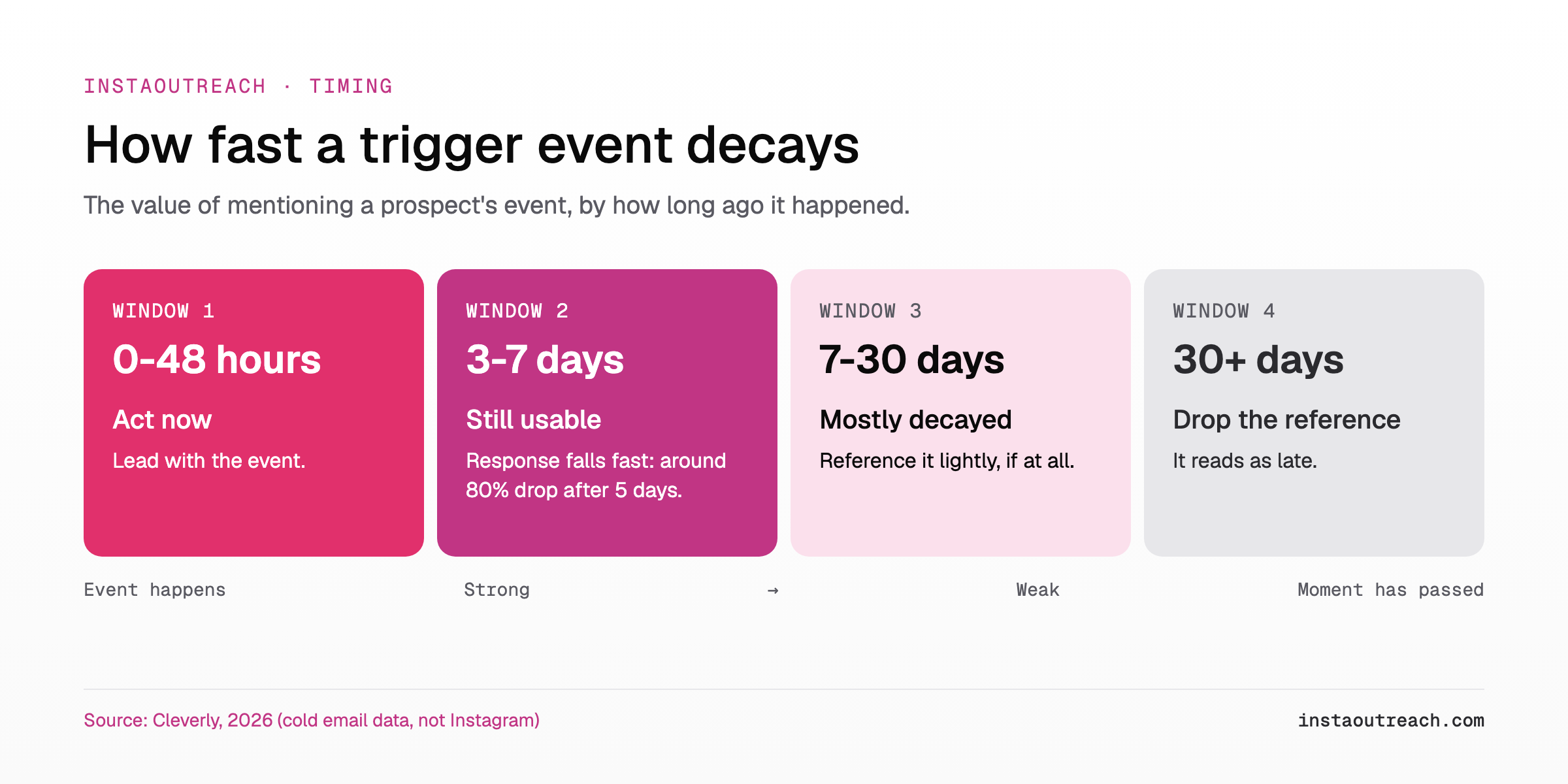
Trigger event outreach means sending a cold DM within roughly 24 to 48 hours of something the prospect just did in public, like opening a new location, posting a hiring call, launching a product or running a giveaway, because that event gives your message a reason to exist. Cleverly, a cold email agency, reports that response to trigger events drops by around 80% after 5 days, so speed matters more than picking the perfect signal.
That is why rewriting your opener for the fifth time rarely fixes a campaign. If the people on your list have no reason to care right now, outreach is aimed at the wrong problem: timing beats copy. This playbook gives you an Instagram trigger library with 10 events, a daily 30-minute scan routine, send-by deadlines per trigger, before/after openers and the capacity math for fitting trigger DMs next to your normal list.
What is trigger event outreach (and why timing beats copy)?
A trigger event is a discrete thing a prospect did that changes what they care about this week. Prospeo, a data vendor, draws the line clearly: trigger events are "discrete, observable occurrences" that open a window, while intent signals are "behavioral patterns (content consumption, keyword searches) that suggest buying interest over time." A salon posting "we're opening a second studio" is a trigger. A salon that has been liking marketing content for months is, at best, an intent signal.
Two things share the name and are not this topic:
- Instagram "DM triggers" in inbound tools are comment-keyword autoresponders ("comment GUIDE and we send it"). That is inbound automation, not prospecting.
- Send timing is the hour of day you hit send. That is covered in our guide to time-of-day send timing and timezone routing. Trigger timing is the time since the prospect's event, measured in days, not hours.
The test that keeps trigger outreach honest comes from Antoine Buteau's piece on trigger-based outbound: "If the same message would be sent without the trigger, the trigger is decoration." Opening with "Congrats on the launch!" and then pasting your usual pitch fails that test. The trigger has to change what you offer, not just the first line.
Cleverly's decay table, built for cold email, is the best public reference for how fast the window closes. It describes buying signals as changing what a prospect cares about for roughly a 7 to 30 day window, with the response cliff after day 5, and says that past 30 days "the moment has basically passed" (Cleverly, 2026). No equivalent public study exists for Instagram DMs, so treat it as a direction, not a law.
Which Instagram trigger events are worth a cold DM?
Every page ranking for this topic lists B2B email triggers: funding rounds, new executives, tech stack changes. The people Instagram outreach targets (salons, gyms, restaurants, coaches, creators, local service businesses) rarely raise a Series B. They do post their moments publicly, on their own feed and stories. Buteau's advice applies directly: "Outbound teams should maintain a trigger library by segment." Here is one for Instagram.
| Trigger | What you see on Instagram | What it usually means for them | Acceptable age (our judgement) | Who should DM it |
|---|---|---|---|---|
| New location / grand opening | "Now open", ribbon-cutting post, new location tag, opening-week offer | Fixed costs just went up; they need local bookings fast | Up to 14 days around opening | Local ads, booking systems, signage, staffing, review tools |
| Hiring post | "We're hiring" post or story, link in bio to an application form | Growing, or overloaded and dropping balls | While the post or story highlight is up | Recruiting help, ops and scheduling tools, outsourced services |
| Product or service launch | Countdown stories, "it's live" post, new product tags | They need the launch to sell, and they are watching numbers daily | First 7 days | Paid ads, UGC, email and SMS, launch content |
| Giveaway or contest | "Giveaway" post with tag-a-friend and follow rules, end date | They are buying attention and will soon need to convert it | Until the giveaway ends, plus 2 days | Follow-up funnels, email capture, retention offers |
| Rebrand | New logo, new handle or name, rewritten bio, refreshed grid | Repositioning; old assets now look wrong | Up to 30 days | Design, web, content, photography |
| New menu, price list or service | Price list carousel, "new treatment" post, menu update | They need people to know about it and try it | Up to 14 days | Promotion, content, ads, booking tools |
| Event or workshop announcement | Event flyer, "tickets in bio", workshop dates | Seats to fill before a hard date | Until the event date | Ticket promotion, ads, event photo or video |
| Collab or new partnership | Collab post, joint giveaway, "partnered with" caption | Open to working with outsiders right now | Up to 14 days | Creators, agencies, complementary brands |
| Milestone post | Anniversary, "1 year in business", follower milestone | Reflecting and planning the next stage | Up to 7 days | Growth services; weakest trigger, pair with another one |
| Complaint or "looking for recommendations" | Story or post asking for a supplier, venting about one | An active, stated problem | 48 hours | Whoever solves exactly that problem |
The acceptable ages above are editorial judgement, not measured data. They follow Buteau's rule: "For each trigger, decide the acceptable age and the reason." Adjust them once your own logs show where replies stop.
How do you find trigger events on Instagram every day?
Instagram sends no alerts when another business opens, hires or launches. Finding triggers is a manual routine, which is also why most of your competitors skip it. Our ranking of Instagram lead sources by intent covers where prospects come from; this routine is about spotting which of them just did something.
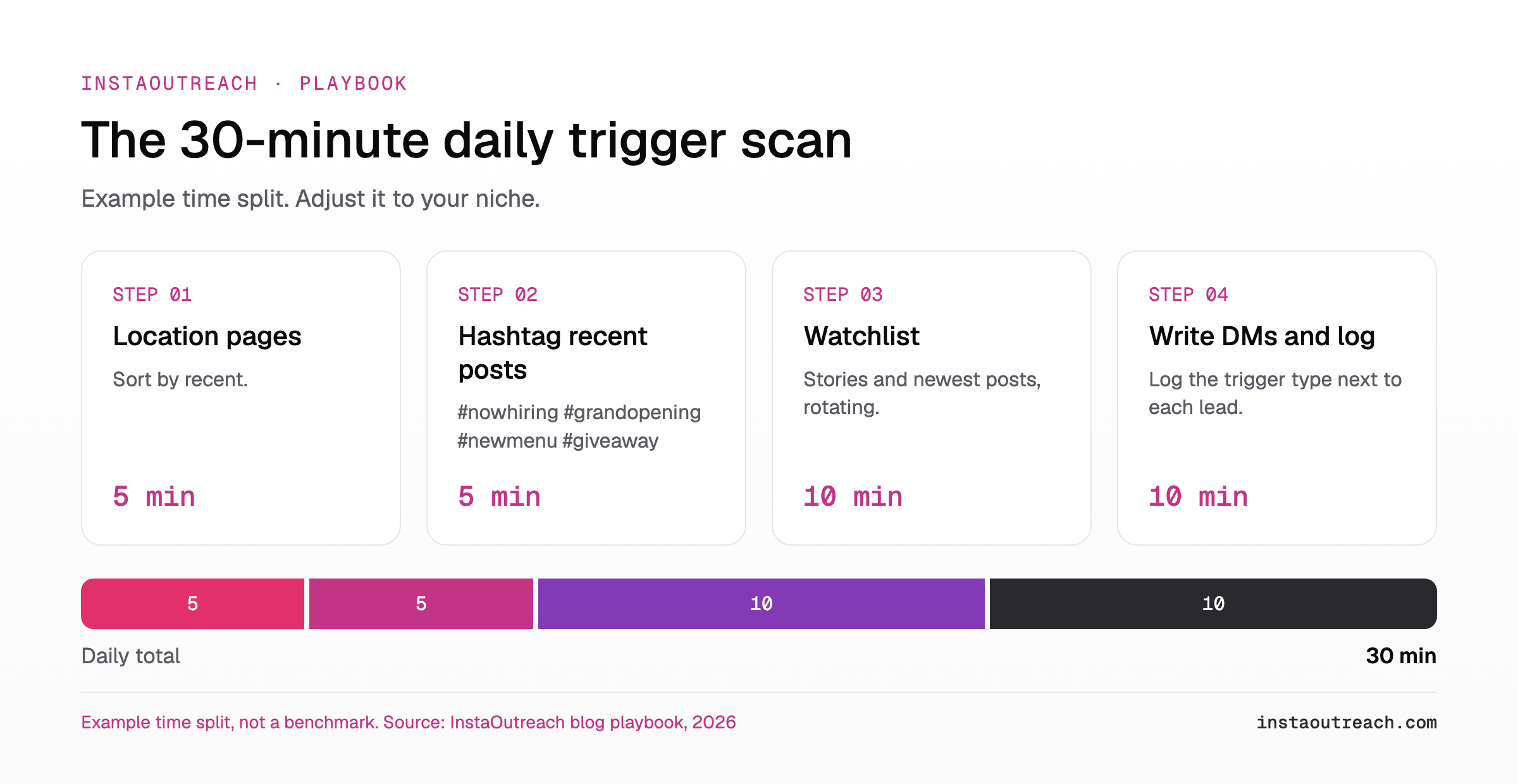
The 30-minute daily trigger scan, step by step:
- Location pages (about 5 minutes). Open the location pages for your city or the neighborhoods you serve and sort by recent. New businesses tag their own address in opening posts.
- Hashtag recent posts (about 5 minutes). Check recent posts under trigger hashtags: #nowhiring, #grandopening, #newmenu, #giveaway, and your niche plus "launch" (for example #salonlaunch). Combine with your city tag where one exists.
- Watchlist check (about 10 minutes). Keep a saved list of prospects who fit your ideal customer. Check their stories and newest posts once a week each, rotating so you cover the list. Commenters on a competitor's launch post belong on this list too.
- Write and log (about 10 minutes). Write the DMs for the triggers you found, and log the trigger type next to each lead.
The time split is an example assumption, not a benchmark. Heavy profile browsing has its own limit, so read about the profile view cap on lead research before you scale the watchlist step.
How fast should you DM after a trigger event?
Send within 24 to 48 hours when you can. Cleverly's reading of its cold email work is blunt: "acting inside 24 to 48 hours beats acting on the 'better' signal a week late," and one of its listed mistakes is "Detecting the trigger, then sitting on it." That is email data from a vendor, but the logic carries over: a business owner who posted a hiring call yesterday is still thinking about staffing today.
Different triggers have different clocks. A hiring post stays relevant while the role is open. A giveaway ends on its end date. A grand opening has a short window before the business settles into routine. Buteau notes that some triggers are short-lived while others "may stay relevant for months", which is why each trigger in your library needs its own deadline.
Rule: If you found the trigger today, send today or tomorrow. If it is more than 30 days old, delete the reference and send a normal opener, or skip the lead. Mentioning a month-old event tells the prospect you are late, which is the opposite of what the trigger was for.
| Trigger | Send by | Drop the reference after |
|---|---|---|
| Complaint / recommendation request | Same day | 48 hours |
| Grand opening | Within 48 hours of the post | 14 days |
| Launch | Within 48 hours | 7 days |
| Giveaway | Before it ends | 2 days after the end date |
| Hiring post | Within 48 hours | When the post or highlight comes down |
| Event announcement | Within 48 hours | The event date |
| Rebrand | Within a week | 30 days |
These deadlines are our judgement built on the public decay data above. The one hard ceiling we borrow is Cleverly's 30-day mark.
How do you write a trigger DM that isn't decoration?
Connect the event to a pressure the prospect now has, then make an offer that fits that pressure. "Congrats on the new spot!" followed by your standard pitch is decoration; it would read the same without the trigger. Buteau calls this "a costume for generic outreach."
The pairs below are examples written for this article, not tested templates. Each trigger-led version names the event, states the pressure it creates and asks one low-effort question.
| Trigger | Decoration version | Trigger-led version |
|---|---|---|
| New location | "Congrats on the new studio! We help salons get more clients. Interested?" | "Saw the second studio opens on Elm St this Saturday. A new location usually has empty chairs for the first few weeks while locals find it. Want me to send the 3 ad angles I'd run for a neighborhood that doesn't know you yet?" |
| Hiring post | "Love your page! We do social media management for gyms." | "Noticed you're hiring two coaches. When a gym is hiring, the owner is usually covering classes and posting less. Would it help if I took the content calendar off your plate for the next month while you onboard them?" |
| Launch | "Congrats on the launch! Let me know if you need marketing help." | "Your new serum went live on Tuesday. The first two weeks decide whether a launch has momentum. I make short UGC-style videos for skincare launches; want two sample hooks for the serum, free, to see if the style fits?" |
| Giveaway | "Cool giveaway! We help brands grow on Instagram." | "Your giveaway closes Friday and it's pulled in a lot of new followers. Most of them forget the account a week later. Want the simple 3-message welcome sequence I'd set up so some of them actually book?" |
Notice what changed: the offer, not just the opener. If your offer stays the same whatever the trigger, read why the offer is usually the bottleneck before you touch the copy. For the structure of each line, see the line-by-line anatomy of a high-reply DM, and for openers outside trigger moments, our Instagram DM openers by situation.
How many trigger DMs can you send in a day?
Fewer than you think, which is the point. Trigger DMs are a priority lane on top of your regular list, not a replacement for it.
Worked example, with stated assumptions:
- Your daily scan finds 12 fresh triggers.
- 8 of them fit your ideal customer.
- Your account sends at a daily limit of 40 DMs. That is the default in InstaOutreach, whose FAQ also lists a hard cap of 75 a day per account; use whatever your own account tolerates.
Then: 8 trigger DMs + 32 list DMs = 40 a day. Over 20 working days that is 8 x 20 = 160 trigger DMs and 32 x 20 = 640 list DMs. Trigger DMs are 20% of volume (8 / 40) but get your best writing time.
We are not giving you a reply rate for either lane, because no public study measures trigger DMs on Instagram. Use variables instead: if trigger DMs reply at r1 and list DMs at r2, the trigger lane earns its scan time when 160 x r1 replies are worth more than the 30 minutes a day you spend finding them. To know r1 and r2, log the trigger type as a field and compare reply rate per trigger, as described in the numbers to log per campaign.
Where automation fits in trigger event prospecting
Spotting and judging the trigger stays human. No tool we know of reads a public Instagram feed of "business events", and the judgement call (is this trigger real, does it fit my offer, is it still fresh) is exactly what makes the message work. Automation earns its place in the parts that do not need judgement: pacing sends inside daily limits, follow-ups, and an inbox where replies do not get lost.
Be clear on the risk: automating Instagram DMs is against Instagram's Terms of Use, and no tool can promise an account stays safe. If you weigh tools anyway, compare how they run and what they cost on a side-by-side tool comparison and check the current plan prices rather than trusting a blog.
How the trigger lane looks in a tool: InstaOutreach can pull leads from a location id, a hashtag's recent posts, or the commenters and likers of a post link you paste, then send within your daily limits from your own browser session, and only while that browser or the Mac app is open (pricing). It does not detect trigger events for you; you pick the source, it handles the sending.
FAQ
What is a trigger event in sales outreach?
A trigger event is a specific, observable thing a prospect did that changes what they care about right now. In B2B email that usually means funding rounds or new executives. On Instagram, the useful triggers are public posts from small businesses and creators: a new location, a hiring post, a launch, a giveaway, a rebrand, a new menu, an event, a collab. Prospeo, a data vendor, defines trigger events as "discrete, observable occurrences" that create a window for a sales action. The trigger gives your cold message a reason to arrive this week instead of any week.
How soon after a trigger event should you send a DM?
Aim for 24 to 48 hours. Cleverly, a cold email agency, reports that response to trigger events drops by around 80% after 5 days and treats anything past 30 days as too late to mention. That is email data, not Instagram, and no public Instagram study exists, but the logic holds: the prospect is thinking about the event right after it happens. Some triggers last longer, like a hiring post that stays up for weeks, so set an acceptable age per trigger type and drop the reference once it passes.
What is the difference between a trigger event and an intent signal?
A trigger event is a single dated occurrence, like a grand opening post or a hiring announcement. An intent signal is a pattern of behavior over time that suggests interest, like repeatedly engaging with content about a problem. Prospeo puts it this way: intent signals are "behavioral patterns (content consumption, keyword searches) that suggest buying interest over time." On Instagram, triggers are easier to use because they are public and dated, and you can reference them directly in the first line of a DM. Intent signals are fuzzier and harder to mention without sounding like you are watching someone.
What are good trigger events for Instagram prospecting?
The strongest Instagram triggers create an immediate pressure: a grand opening (needs local customers fast), a hiring post (growing or overloaded), a product launch (needs the launch to sell), a giveaway (needs to convert new followers), and a public request for recommendations (an active, stated problem). Rebrands, new menus or price lists, event announcements and collabs are solid second-tier triggers. Milestone posts are the weakest and work best combined with another trigger. Match each one to an offer that fits its pressure; a trigger that does not change your offer is decoration.
Does trigger-based outreach get higher reply rates?
Vendors say yes. Cleverly claims signal-based cold emails land 5 to 18% reply rates versus roughly 8.5% for generic cold email. Treat those as vendor claims about email. Prospeo itself warns that triggered-message stats get inflated because triggered messages are "inherently lower-volume and higher-intent," which flatters any comparison against batch sends. There is no public study for Instagram DMs. The reliable way to know is to log the trigger type on every DM and compare reply rates per trigger against your regular list over a few weeks.
Can a tool detect Instagram trigger events automatically?
Not in any reliable way we know of. Instagram offers no public feed of business events, and outreach tools generally source leads from places you choose: hashtags, location pages, a competitor's followers, or the people who commented on or liked a specific post. That gets you close to triggers, for example recent posts under #grandopening, but deciding that a post is a real trigger, still fresh and a fit for your offer is a human call. Plan for a short daily manual scan and let software handle sending, follow-ups and the inbox.