Find Course Creators on Instagram: The Agency List-Building Guide
No complete public list of course creators exists. Here are six places to build one, ranked by how clearly each proves someone sells courses or coaching, plus a sheet to qualify them.
No complete public list of course creators exists, and any list sold on subscription can also reach that vendor's other subscribers. To find course creators on Instagram, build your own list: start where people already sell (Skool Discovery, bio links, paid ads), then match each seller to an Instagram handle.
That order matters because you are pitching a business, not an audience. As an assumed example, an account with 40,000 followers and no offer has nothing to pay you from. An account with 900 followers and a live $149 a month community does.
This guide covers only people who sell courses and coaching, as prospects for your services. For lead sources in general, read how to find and qualify Instagram leads. If you want creators to promote your product, that is a different job: see recruiting creators by DM.
Is there a list of online course creators you can just download?
Not a free, complete one. You have three real options: buy a list, scrape one, or build one by hand.
Bought lists exist. CoachingLeads, as listed on Toolmage (listing added August 2025, checked November 2026), promises a CSV of 2,000 coaching leads a month at a promotional $97 a month, regularly $197. The listing says each lead has at least 5,000 Instagram followers, activity in the last 7 days, and evidence of marketing or selling. It also says the platform limits new customers per month to keep lists fresh. Those are vendor claims, so confirm the current price with the vendor. Before you pay for any list, ask how many other customers receive the same leads, then spot-check 20 of them with the seller test below.
Scrapers exist too. One Apify actor example collects public emails by hashtag and returns username, email, full name, followers and verified status. Nothing in that output tells you whether the person sells anything. There is also a terms problem: Instagram's Terms of Use bar "accessing or collecting information in an automated way without our express permission."
Shared sources have one more cost. When several agencies work the same names, replies fall for everyone, which is the list burn in a saturated niche problem.
| Option | Cost | Freshness | Who else has it | Terms exposure |
|---|---|---|---|---|
| Buy | Monthly fee, for example $97 promo, $197 regular on one August 2025 listing | Whatever the vendor states | Ask the vendor | Depends on how the vendor collected it |
| Scrape | Tool fee plus cleanup time | Current at run time | Anyone running the same hashtag | Automated collection, barred without permission |
| Build by hand | Your time | You date every row | Only you, as a compiled list | Normal manual browsing |
For a pitch list of 50 to 200 names, building wins. The rest of this guide shows how.
Where to find course creators on Instagram: six sources ranked by proof of selling
Most advice starts inside Instagram and works outward. Reverse it. Start with the evidence that money is changing hands, and use Instagram last, to find the handle you will message.
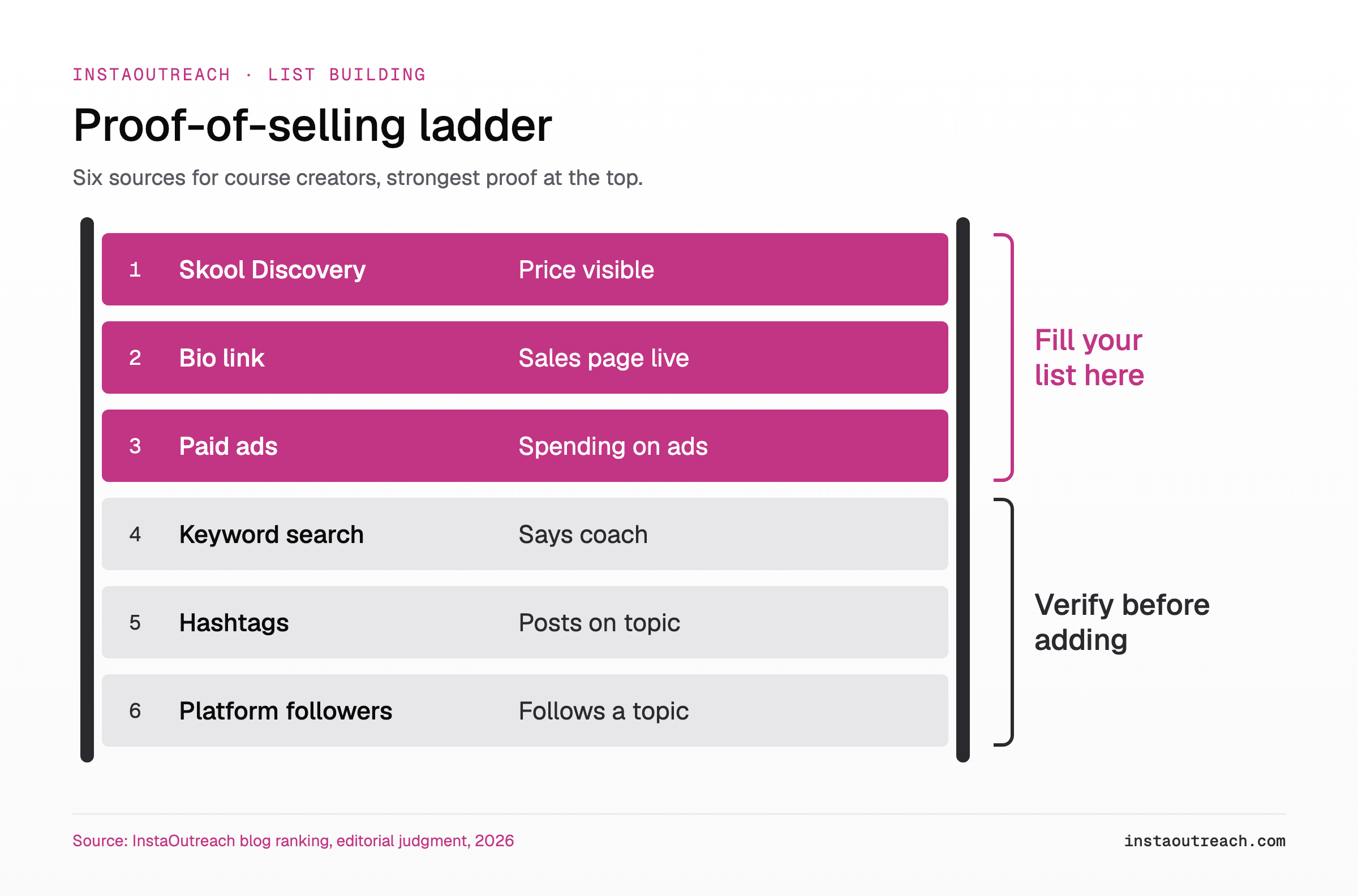
The ranking below is my judgment, not a measured result. It sorts sources by how much each one proves about a person's business before you spend time on them.
- Skool Discovery. A public price sits on the listing itself.
- Bio links to a checkout or sales page. A live offer exists, though you still have to click through.
- Running paid ads. Someone is spending money to sell something.
- Instagram keyword search. The person calls themselves a coach. That is a claim, not proof.
- Hashtags. The person posts on the topic. Students and fans use the same tags.
- Followers of course platforms or big educators. These accounts follow a topic, and in my view most of them are buyers rather than sellers.
Use rungs 1 to 3 to fill the list. Use rungs 4 to 6 only when a niche has too few visible sellers, and run every result through the seller test.
How to use Skool Discovery to find coaches who already charge
Skool Discovery is the best starting point because the public cards show a member count and a monthly price, and usually a rating. You see the offer before you see the person. On the first page of Skool Discovery in November 2026, all 30 listings showed a monthly price and 29 showed a rating, with prices including $9, $49, $97, $149 and $249. That page is a trending view, so treat it as a snapshot, not a rule for the whole site.
Work it in four steps:
- Filter by a category that fits your service. The category bar includes Health & Fitness, Business, Self Improvement, Personal Finance and Real Estate.
- Note the community name, member count, price and category in your sheet.
- Open the about page and look for the owner's name or Instagram link.
- If no link appears, search the owner's name on Instagram and confirm the handle links back to the same offer.
Then run the listing math. Multiply price by members to get a monthly revenue ceiling. This is our own calculation from public card data, and it is a ceiling only: the card does not show who actually pays, so real revenue is lower.
| Assumed members | Assumed price per month | Ceiling (members x price) | What it suggests |
|---|---|---|---|
| 1,000 | $9 | $9,000 | Big audience, low price: likely wants retention help |
| 200 | $49 | $9,800 | Mid-priced community with room to grow |
| 60 | $149 | $8,940 | Small group, high price: likely wants more applicants |
All three rows are assumed examples, not real communities. Notice that the ceilings land within about $900 of each other even though member counts differ by more than 16 times. Member count alone would have ranked these prospects wrongly.
Use the ceiling to set a floor for your list. As an assumed example, say your retainer is $1,500 a month and you want it to stay under 20% of a prospect's ceiling. Then $1,500 / 0.20 = $7,500, and anything below that ceiling drops off the list. Change both numbers to fit your offer.
How to tell a course seller from someone who just talks about courses
Open the bio link every time. A community answer on Deepline includes the same check, inside a scraping method we do not recommend: look for links to platforms such as Skool and Circle, then click through to the site's About page for contact details.
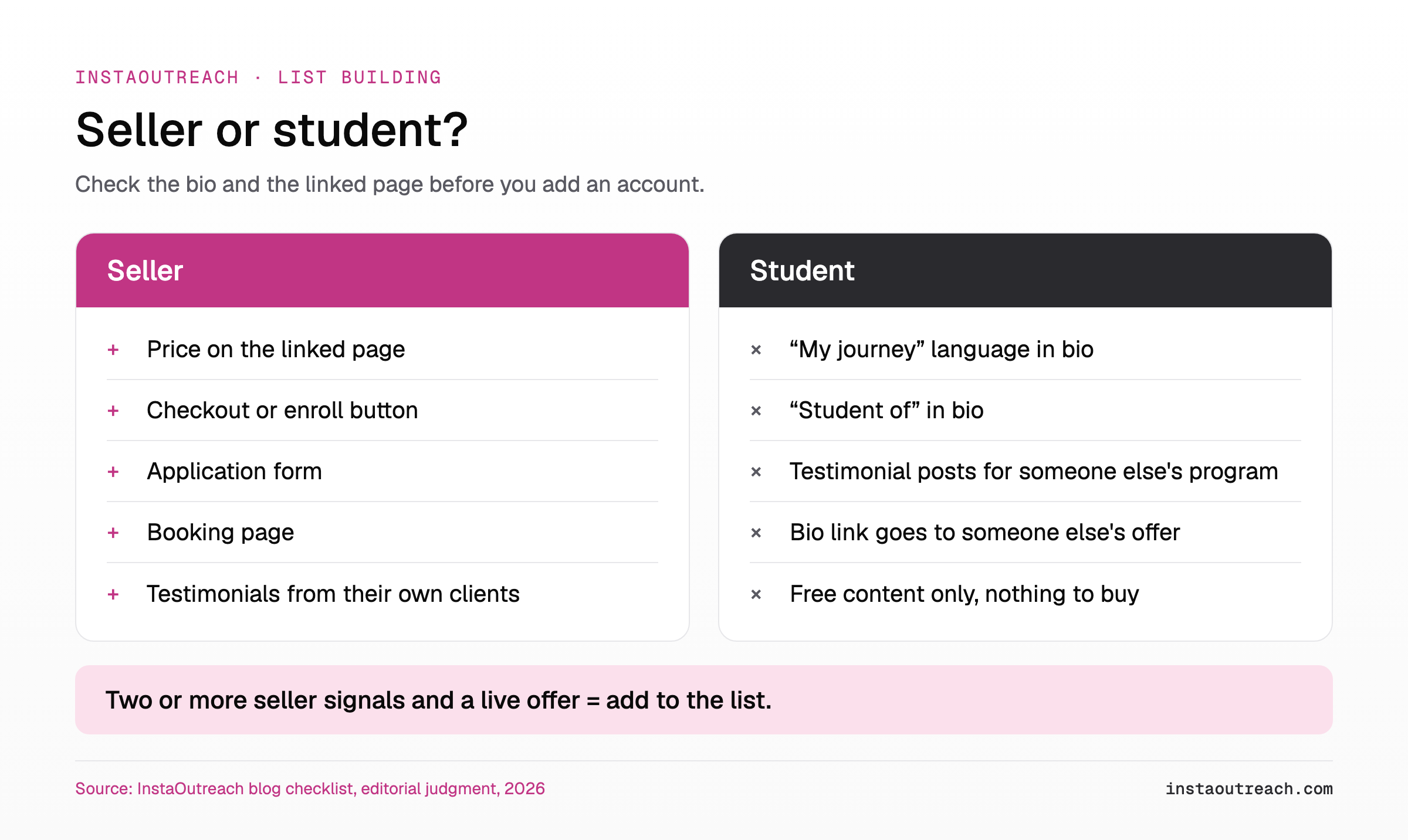
A seller's link ends at a price, a checkout, an application form or a booking page. Platforms worth recognizing in a bio include Skool, Circle, Stan, Kajabi, Teachable, Thinkific and Whop. The platform name alone is not proof, so open the page and check that an offer is live.
The test: two or more seller signals, such as a price, a checkout, an application form, a booking page or testimonials from their own clients, plus a live offer.
Students look similar at a glance. Watch for "my journey" language, "student of" in the bio, and testimonial posts praising someone else's program. These people may be fans of your real prospect, so note who they praise. That name can be a lead.
Two checks finish the job. If the account looks team-run, find the person behind a business page before you write anything. If you are unsure about audience size, see which follower counts to target.
How to find coaches on Instagram with keyword search and hashtags
These are rungs 4 and 5, so expect more noise. Matt McWilliams' guide to finding affiliates describes both methods: keyword search now surfaces accounts by topic rather than only exact handle matches, and hashtag research means checking both the top and recent tabs. His guide targets affiliates, but the search mechanics carry over.
Search phrases that a seller would write, not words a fan would use. Phrases like "apply to work with me" and "free training" point to a funnel, which is more useful than a bare niche word.
| Niche | Search phrase | What to check on the profile |
|---|---|---|
| Business coaching | "business coach for" | Who they serve, and whether the bio link ends at an application or booking page |
| Mindset coaching | "mindset coach" | A paid program or only free content |
| Any course niche | "free training" | Whether the free training leads to a paid offer |
| High-ticket coaching | "apply to work with me" | A live application form, and recent posts |
Every profile you open is a profile view, and bulk checking adds up. Spread the work out and read about the profile view limit during lead research before a big session.
How to spot coaches already spending on ads
Paid ads sit on rung 3 because spending money is a stronger signal than posting. Meta Ad Library is public, so you can search niche terms and see who is running ads. An active ad shows that someone is paying for attention right now, and it usually points to the offer itself.
Follow each ad one step further. Open the landing page, record what is sold and at what price if shown, then find the Instagram handle from the page or the advertiser's profile.
A launch is a timing signal as well as a proof signal. If a coach has just started promoting a new program, your pitch can reference it. The method is covered in trigger event outreach.
What columns should a coach lead list have?
Use twelve columns. Each one either qualifies the lead or feeds the pitch, and anything else is clutter.
| Column | Sample row 1 (fictional) | Sample row 2 (fictional) |
|---|---|---|
| Handle | @sample.coach | @example.mentor |
| Name | Sample Coach | Example Mentor |
| Niche | Fitness for new moms | Bookkeeping business |
| Offer type | Community | 1:1 |
| Sell link | Skool page URL | Application page URL |
| Price seen | $49 a month | Not shown |
| Source | Skool Discovery | Meta Ad Library |
| Proof rung (1-6) | 1 | 3 |
| Team-run | No | Yes |
| Email found | No | Yes |
| Pitch angle | Low member growth for the price | New program launch |
| Last checked | Date of check | Date of check |
For offer type, stick to four values: course, community, 1:1 or group. Fixed values let you filter and sort the sheet later.
Pass rule: keep a row only if it sits on rung 1 to 3 or has a price seen, and the account was active in the last 30 days. The 30 days is an assumption, so tune it to your niche.
Here is a worked example with assumed numbers:
- Raw handles collected: 200
- Confirmed sellers after the seller test: 80 (80 / 200 = 40%)
- Pass the rule: 50 (50 / 200 = 25% of raw, 50 / 80 = 62.5% of sellers)
So in this example, a 50-name pitch list takes 200 handles of research. Track your own ratio on the first batch, then use it to plan how much research each list needs.
The email column carries legal duties if you use it. In the US, the FTC says CAN-SPAM "makes no exception for business-to-business email", and opt-outs must be honored within 10 business days. Other countries have their own rules. The cold DM compliance map has the wider picture, and the two-channel DM and email sequence shows how to combine both. For the pitch itself, start from these Instagram DM templates.
Which tool should you use to work the list?
A list of 50 to 200 names needs no scraper. A spreadsheet is enough to build and qualify it. A tool only matters at the sending stage, and there the choice comes down to where it runs, what it costs per account and how it takes in your list.
Start with this side-by-side tool comparison. If you are weighing one specific product, the ColdDMs alternatives page covers that choice, and per-account pricing answers the cost question.
Note: Automating Instagram DMs or lead collection is against Instagram's Terms of Use, whichever tool you use, and no tool can remove that risk. A small, well-qualified list also means fewer messages to send in the first place.
If you use InstaOutreach, your sheet imports as a CSV with column mapping into your own fields (up to ten custom fields, so pick the columns you need at the sending stage), and it runs in your own browser through the Chrome extension or Mac app rather than in the cloud, so sending stops when the browser or app is closed.
FAQ
Where can I find a list of online course creators?
No complete public list exists, so the practical answer is to build one. Start with Skool Discovery, where public cards show a member count and monthly price, and usually a rating. Add people whose Instagram bio links end at a checkout or sales page, then people running paid ads found through Meta Ad Library. Paid lists exist as well, but ask how many other customers receive the same leads. A hand-built list of 50 to 200 confirmed sellers is usually more useful than thousands of unchecked names, because each row has already passed a proof-of-selling test.
How do I find coaches on Instagram to pitch my services?
Start outside Instagram, where selling is visible, then match each seller to a handle. Inside Instagram, use keyword search with phrases a seller would write, such as "apply to work with me" or "free training", and check recent posts on relevant hashtags. Open every bio link and look for a price, checkout, application form or booking page. If none of those appear, the account may be a student or fan rather than a business. Record each confirmed seller in a sheet with the offer, the price seen and a specific pitch angle.
Are bought coach lead lists worth it?
It depends on what you can verify. One listing on Toolmage, added in August 2025 and checked in November 2026, shows 2,000 leads a month at a $97 promotional price, regularly $197, and the vendor describes its own checks. No independent review turned up, so treat those as vendor claims and confirm the current price with the vendor. Before you subscribe, ask how many other customers get the same leads and how each one was collected. Then test 20 rows by opening the bio link and looking for a live offer. If most rows pass, the list may save you research time.
Is it legal to scrape Instagram for leads?
Scraping raises at least a contract problem. Instagram's Terms of Use bar collecting information in an automated way without express permission, whether or not you are logged in. Running a scraper from your account therefore goes against those terms and puts that account at risk. Whether it also breaks a law depends on your country, the data and what you do with it. This is general information, not legal advice. The cold DM compliance map covers the wider rules, and for anything high-stakes you should ask a lawyer in your jurisdiction.
How many followers should a course creator have before I pitch them?
There is no universal number, because followers do not pay invoices. Revenue signals matter more, so a small account with a live paid community can be a better prospect than a large account with nothing to sell. Check for a price or checkout first, then use follower count as a secondary filter that fits your offer. Larger accounts may have a team, which changes who reads your message. For a closer look at how size affects a cold pitch, see which follower counts to target. Set your own range after the first batch of replies.
How can I tell how much a coach earns?
You can only estimate a ceiling from the outside. For a paid community with a public card, multiply the monthly price by the member count. As an assumed example, 200 members at $49 a month gives 200 x $49 = $9,800 a month. Real revenue is lower, because the card does not show who actually pays and it says nothing about costs. Use the figure to compare prospects and set a minimum for your list, never to quote someone's income back to them. Coaches who sell through applications often show no price, so record that as unknown.