Cold DM Ecommerce Brands: When to Switch to Email or LinkedIn
Cold DMs to ecommerce brands fail when the person reading the inbox cannot buy. How to spot that before you send 300 DMs, and when email or LinkedIn reaches the founder instead.
Cold DM ecommerce brands on Instagram only when the founder still answers the DMs, which usually means a small, founder-led brand; once a social or community manager runs the inbox, a pitch for consulting, CRO or agency work rarely reaches anyone who can buy. If 100 to 150 DMs to one segment produce no replies (fewer than 1 or 2), stop rewriting the message and move that segment to email or LinkedIn.
That is a rule of thumb, not a law, and the arithmetic behind it is below. This playbook covers who actually reads an ecommerce brand's Instagram inbox at each stage, the profile signals that tell you the channel before you send, the stop rule, and a 3-channel sequence with ready message texts. For the generic pros and cons of each channel, see the full comparison of Instagram DM, cold email and LinkedIn; this post is the ecommerce-specific version.
Does it make sense to cold DM ecommerce brands on Instagram?
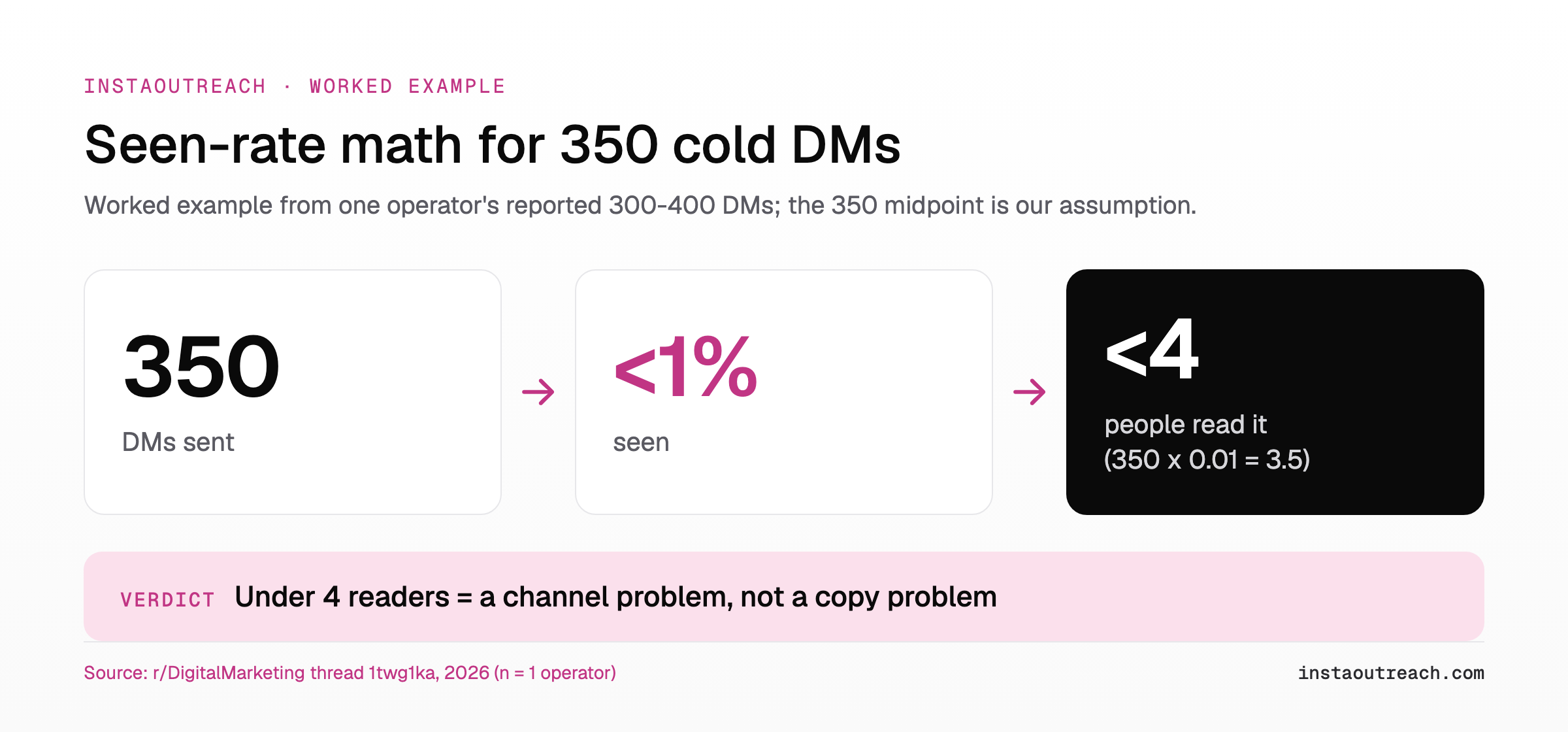
Sometimes, and the deciding factor is who sits behind the inbox, not how clever the opener is. A useful case: one operator on r/DigitalMarketing reported selling consulting and UX audits to UK ecommerce brands over Instagram, with a "data set of around 300-400 DMs", an "open rate less than 1%" and no conversions. Knowledge Hub Media retold the same thread in 2026. Treat it as one person's report, not a benchmark.
"Open rate" on Instagram means something specific: the message request was seen. A cold DM from an account the brand does not follow lands in Requests, and often in Hidden Requests, which is covered in detail in why cold DMs land in Hidden Requests. So the reported number is a visibility number, not a reaction to the copy.
Worked example, using the reported figures. Assumption: 350 DMs, the midpoint of the 300 to 400 range (our assumption, not the operator's). Under 1% seen means 350 x 0.01 = 3.5, so fewer than 4 people ever read the message. No copy change can be judged on 3 or 4 readers. That is a routing problem: the message is not reaching a person, let alone the person who can sign off on a UX audit.
Who reads an ecommerce brand's Instagram DMs?
It depends on the brand's stage, and the inbox changes hands earlier than most sellers assume. In the same thread, one commenter put it plainly: "The person fielding Instagram DMs is not usually the decision maker for something like UX or sales pipelines. They're probably trained to ignore cold messages." That is a claim from experience, not data, but the mechanism holds: a brand's DM inbox fills with customer questions, order issues, creator collab requests and spam, and whoever triages it learns to skip pitches.
The table below maps the typical inbox owner by stage. It describes roles, not percentages; no public dataset measures this.
| Brand stage | Who reads the DMs | What they can approve | Best first channel | What to ask for |
|---|---|---|---|---|
| Solo, founder-led | The founder | Anything, including paid work | Instagram DM after a warm touch | A short reply to one specific question |
| Small team, VA or part-time social person | VA or freelancer, founder checks sometimes | Nothing paid; can forward | Email to the founder, IG as backup | Who handles growth or the website |
| Social or community manager, or an agency | Social manager or agency staff | Content and creator deals only | Email or LinkedIn to founder or ecommerce manager | Nothing on IG; do not pitch here |
| Large brand with customer-service tooling | Support agents working a ticket queue | Refunds, order questions | LinkedIn to the ecommerce or growth lead | Nothing on IG |
The practical point: the bigger the brand, the less your Instagram DM is a sales message and the more it is a support ticket nobody asked for. Founder-led brands under a few people are where cold DMs to ecommerce brands still make sense.
Signals that say switch to email or LinkedIn before you send
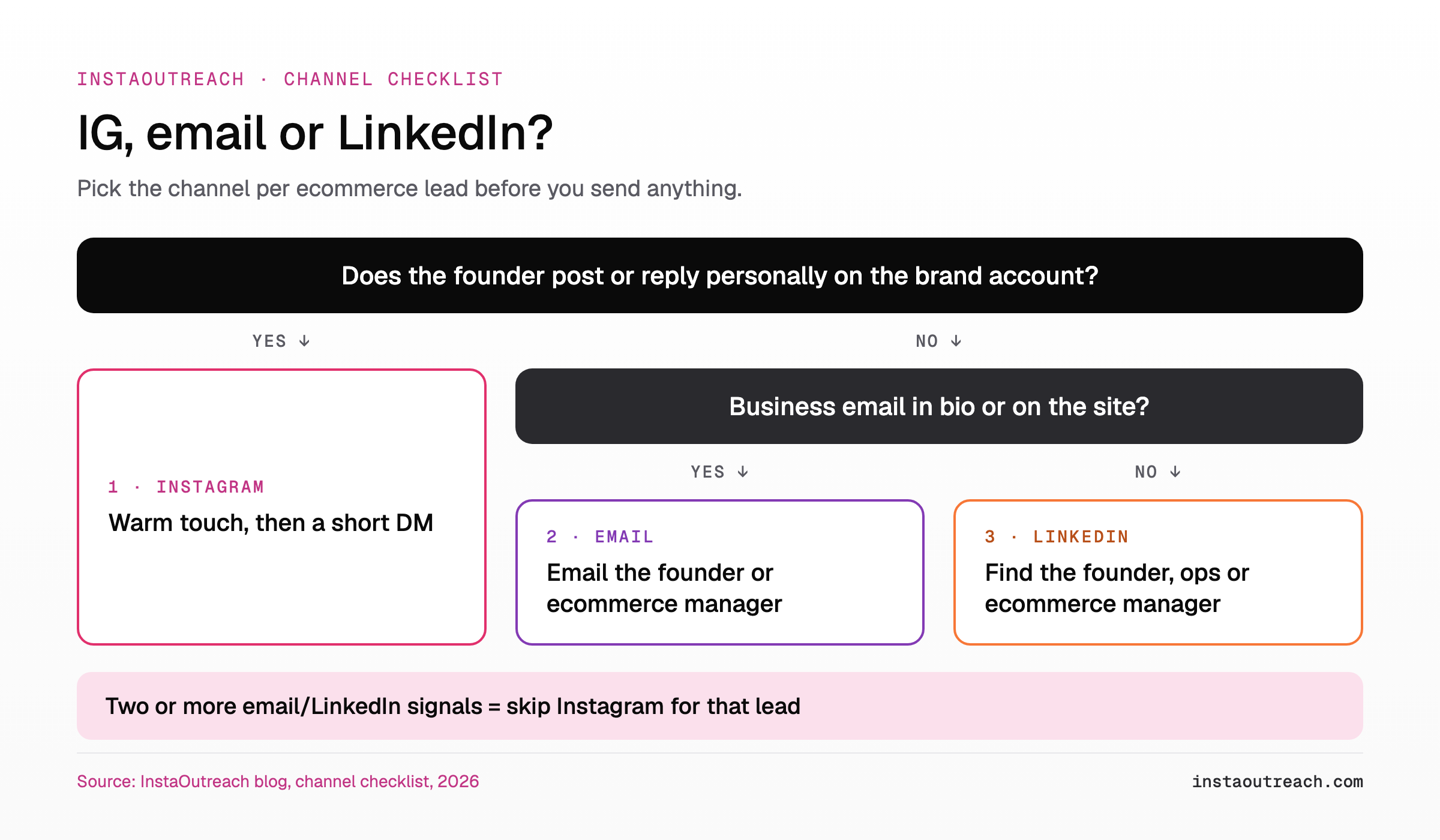
You can usually read the channel off the profile in under a minute. Run this checklist on every ecom lead before it goes into an Instagram campaign.
| Signal on the profile or site | What it tells you | Channel |
|---|---|---|
| Business email in bio (hello@, partnerships@, founder's name@) | The brand expects business mail there | |
| "DM for collabs" or "message for orders" | The inbox is for creators and customers | Email or LinkedIn |
| Link in bio goes to a support desk or help center | DMs are probably routed to support | Email or LinkedIn |
| Team or About page lists a founder, ops or ecommerce manager | You know the buyer by name | LinkedIn or email |
| Founder posts personally on the brand account (face, voice, first person) | The founder is likely in the inbox | |
| Comments and story replies answered by the founder by name | The founder reads engagement directly |
There is a useful reverse signal from influencer marketing guides: brands that list a partnerships email in bio route creator deals there, so a business email in the bio is the brand telling you where business goes. If two or more rows point to email or LinkedIn, skip Instagram for that lead.
How many DMs before you know Instagram is the wrong channel?
Use a per-segment stop rule: send 100 to 150 DMs to one segment (one niche, one offer), then judge. The rule is our heuristic, and here is the arithmetic. Suppose a fair reply rate for the segment were even 2% (an assumption for the example, not a benchmark). At 150 sends you would expect 150 x 0.02 = 3 replies. The chance of getting zero replies at a true 2% rate is 0.98 to the power of 150, about 5%. At 100 sends it is 0.98 to the power of 100, about 13%. So zero replies after 150 sends is strong evidence that something structural is wrong, and 100 is the earliest point it is worth a look.
Before you blame the channel, split the failure into its parts. "Not seen" and "seen but ignored" need different fixes, and mixing them is how operators end up rewriting good copy for months. Log the numbers that make this possible, as described in numbers to log for every campaign. And if you are comparing two versions of a message, read up on how many sends an A/B test needs first: at these volumes, small differences are noise.
| Symptom after 100 to 150 sends | Likely cause | Fix |
|---|---|---|
| Not seen (few or no requests opened) | Requests or Hidden Requests, or the wrong inbox owner | Warm touch first, or move the segment to email or LinkedIn |
| Seen, no reply | Offer or copy: pitch too early, wrong priority | Change the offer and the ask, not just the wording |
| Replies, but no calls | Handoff: slow replies, asking for a call too soon | Answer fast, offer the finding before the call |
In the UK case, the message was seen by too few people to say anything about the copy. But the copy had a second problem a commenter pointed out: "your message assumes the UX issue is the problem they're prioritizing right now. Even if you're correct, they may be thinking about inventory, CAC, retention, or cash flow instead." That is an offer issue, and why the offer, not the wording, is the bottleneck goes deeper on it.
Cold email to ecommerce founders: what to expect
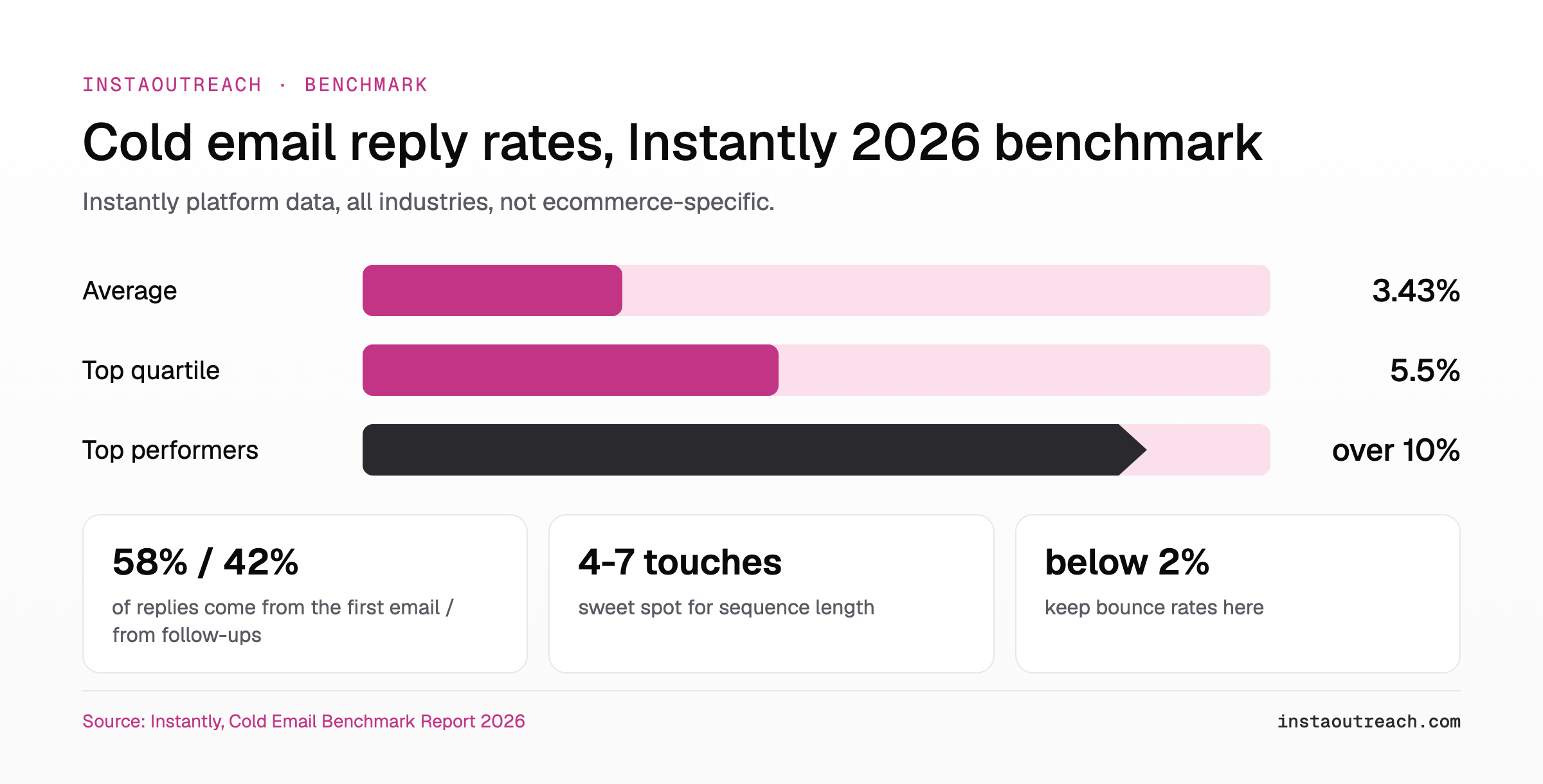
Email has the one thing a brand's Instagram inbox lacks: it usually reaches a named person. The best public reference is Instantly's 2026 benchmark of its own platform, which reports an average reply rate of 3.43%, a top quartile at 5.5% and the top performers above 10%. These are all-industry numbers from one vendor's users, not ecommerce-specific, so use them as a sanity range, not a target.
Three other findings from the same report shape the sequence below. The first email captures 58% of replies and follow-ups the remaining 42%, so a single email leaves almost half the replies unclaimed. The sweet spot is 4 to 7 touchpoints. And bounce rates should stay below 2%, which means verifying addresses before you send.
Where to find an ecommerce founder's email, in order of effort:
- The Instagram bio and the contact button on the profile.
- The store's footer and Contact page; most Shopify stores have one.
- The About or Team page, which often names the founder; combine the name with the store domain and verify.
- The founder's LinkedIn profile, which sometimes lists a contact address.
When LinkedIn beats Instagram for ecom brands
LinkedIn wins when the offer is about the business rather than the brand's content. The same Reddit thread made the point directly: for UX audits and conversion consulting "you're often selling to founders, operators, or ecommerce managers. Many of them spend more time on LinkedIn, in ecommerce communities, or Slack groups," one commenter wrote. Those people often have LinkedIn titles that say exactly what they own, which is something an Instagram handle never tells you.
One mechanical difference: on LinkedIn you usually need an accepted connection before you can message someone. As AgentDM's comparison puts it, "Connection requests are required before InMail unless you have a Premium/Sales Nav subscription." So the first LinkedIn touch is a connection, not a pitch. Published LinkedIn reply-rate figures we found had no underlying source, so there are none here.
| What you sell to ecom brands | Who buys it | Best first channel |
|---|---|---|
| UGC, creative, social content | Founder or social lead | |
| Influencer or creator programs | Founder or partnerships lead | Instagram, or the partnerships email |
| CRO, UX audits, site speed | Founder or ecommerce manager | Email or LinkedIn |
| Email and SMS flows, retention | Founder or retention/CRM lead | Email or LinkedIn |
| Ops, 3PL, finance, inventory | Founder or ops lead | LinkedIn or email |
| Paid ads management | Founder or growth lead | Email plus a warm Instagram touch |
The UK operator was selling the third row through the first row's channel. That alone explains most of the result.
A 3-channel sequence for one ecommerce lead
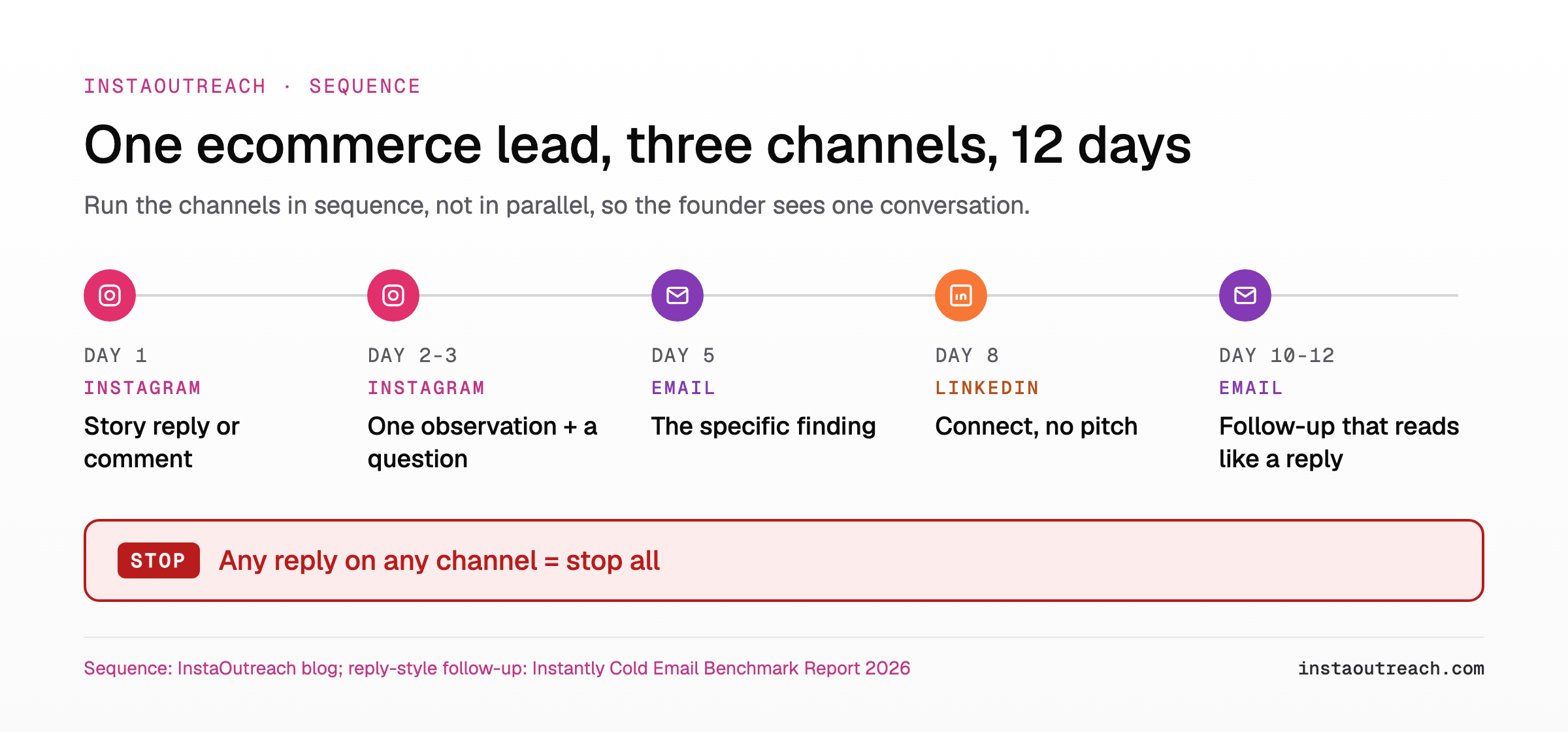
When a lead is worth more than one channel, run them in sequence, not in parallel, so the founder sees one consistent conversation instead of three pitches on the same day. This is the ecommerce version of the two-channel DM plus email sequence, with LinkedIn added for the buyer who is not on Instagram.
| Day | Channel | Action |
|---|---|---|
| 1 | Warm touch: a real story reply or comment, no pitch | |
| 2 to 3 | Short DM: one observation and a question | |
| 5 | The specific finding, one low-commitment question | |
| 8 | Connection request, no pitch in the note | |
| 10 to 12 | Follow-up written as a reply to your own email | |
| Any day | All | Stop every channel the moment they reply anywhere |
The day 1 warm touch matters because a brand that has interacted with you is less likely to bury the DM; story replies and comments as a warm entry covers how. The day 10 to 12 email follows Instantly's advice to "make step 2 of your campaign feel like a reply", which the same report credits with roughly a 30% lift; that is the vendor's claim. For spacing beyond this, see the follow-up cadence post.
The three messages
These rewrite the UK operator's original message around the founder's priorities (inventory, CAC, retention, cash flow) instead of leading with the UX problem. Replace everything in brackets with something you actually found on their store.
Instagram opener (day 2 to 3):
IG DM: Hey [first name], loved the [specific product or launch] drop. Quick one: I noticed [one specific thing, e.g. the size guide is only on desktop]. Is the site something you look after yourself, or is there someone else I should ask?
Email (day 5):
Subject: [Brand] checkout on mobile
Hi [first name], I went through [brand]'s store on my phone this week. On [product page], [specific finding, e.g. the add-to-cart button sits below three image swipes]. On stores your size, that usually shows up as lost orders on paid traffic, which hits CAC first. Happy to send the two-minute screen recording, no call needed. Want it?
[Your name]
LinkedIn connection note (day 8):
LinkedIn note: Hi [first name], I work with ecommerce brands on [your area, e.g. site conversion]. Sent you a short note about [brand]'s mobile checkout by email last week. Would be good to connect.
Each one makes one point, offers something useful without a call, and asks a question that takes five seconds to answer. None of them asks for 15 minutes.
Tools for each leg
Run email and LinkedIn in the tools built for them. For the Instagram leg, compare options on the Instagram DM tool comparison page or the alternatives list, and check what the Instagram step costs per account on the pricing page. If you automate it, know that automating Instagram DMs is against Instagram's Terms of Use, and no tool can make it risk-free. InstaOutreach can run the Instagram leg only, as a Chrome extension or Mac app in your own browser that sends only while the browser or app is open, with email and LinkedIn handled elsewhere.
FAQ
Do cold DMs to ecommerce brands still work in 2026?
They work when the founder reads the inbox, which mostly means small, founder-led brands. Once a social manager, an agency or a support team runs the Instagram account, a cold pitch for consulting or services usually never reaches the buyer. One operator selling UX audits to UK brands reported under 1% of around 300 to 400 DMs being opened and no sales. Check the profile first: if the founder posts and replies personally, DM after a warm touch. If not, use email or LinkedIn.
Is it better to email or DM an ecommerce brand?
For anything a founder or ecommerce manager has to approve, such as CRO, retention, ops or ads management, email is usually the better first channel because it reaches a named person. Instagram DMs fit creative, UGC and creator offers, and founder-led brands where the founder runs the account. A business email in the bio is the brand telling you where business goes. For reference, Instantly's 2026 benchmark reports a 3.43% average cold email reply rate across its platform, all industries, which is a vendor figure and not ecommerce-specific.
Why are my Instagram DMs to brands not being seen?
A DM from an account the brand does not follow goes to message requests, and often to Hidden Requests, where many brands never look. Even when requests are checked, the person doing it is often a social manager or support agent trained to skip pitches. So a low seen rate is usually a routing problem, not a copy problem. Fix it with a warm touch first (a genuine story reply or comment), or move the lead to email or LinkedIn. More on the mechanism in why cold DMs land in Hidden Requests.
How do I find an ecommerce founder's email address?
Start with what the brand publishes: the Instagram bio and contact button, then the store's footer and Contact page, which most Shopify stores have. Next, the About or Team page often names the founder; pair the name with the store's domain and verify the address before sending. The founder's LinkedIn profile sometimes lists contact details too. Verification matters because Instantly advises keeping bounce rates below 2%, and guessed addresses push that up quickly.
Should I cold message ecommerce founders on LinkedIn instead?
For business-side offers, often yes. Founders, ops leads and ecommerce managers list their role on LinkedIn, so you can reach the actual buyer instead of whoever triages Instagram. The catch is that you usually need an accepted connection first: AgentDM notes that connection requests are required before InMail unless you pay for Premium or Sales Navigator. Send the connection without a pitch, reference an email you already sent, and keep the actual message short and specific to their store.
How many follow-ups should I send an ecommerce brand?
Across all channels, plan 4 to 7 touches in total, which is the range Instantly's benchmark calls the sweet spot for cold email; beyond seven, returns drop unless each touch adds something new. Follow-ups matter: in the same data, 42% of replies came after the first email. Spread the touches across Instagram, email and LinkedIn over about 12 days, and stop every channel the moment the brand replies on any of them. Each follow-up should add a new detail, not repeat the pitch.